Showing posts with label jrpg - snes. Show all posts

Sunday, August 16, 2020

XP for Exploration - Maps, Monster Drawings, and More!

In a game about traveling, it makes sense that experience might primarily come from travel itself rather than from finding treasures or defeating monsters.


In Ryuutama, players earn a single XP award each time they finish a "leg" of their journey, based on the most difficult terrain they passed through on that part of their trip. You can earn 100-500 experience per trip, depending on the terrain and weather, plus a possible bonus for the most difficult combat, typically another 30-60. The XP totals needed to level up are comparable to 5e.

Players are encouraged to keep travelogues about their journeys, but I don't think there's a mechanical benefit to doing so. There is one other possible reward though - once per section of the trip, a Minstrel character can write a song about either the weather or the terrain, then sing it later under similar conditions to help out the other party members.

One consequence of this system is that it's more rewarding to take trips with short legs and frequent stopovers than to travel long stretches without visiting a town. It's an experience system that is well-suited to a game where you're traveling through settled lands, and where you're interested in staying awhile in each settlement. It would work less well in a campaign where you're exploring trackless wilderness, or where you pause at waystations so briefly that they're little different from any other campsite. It's also an experience system that's better suited to maps where players have some freedom to decide both where they'll travel and how they'll get there. It would work less well on map with only a single fixed route.


In Neoclassical Geek Revival, Zzarchov also awards XP directly for travel and exploration. Zzarchov's system is intended to reward and encourage longer journeys. Each session, each new room visited within a dungeon is worth more XP than the previous room - but if the players leave the dungeon, the reward resets to zero. The goal is to tempt players, perhaps against their better judgment, to press on further each delve than they might go otherwise.

"Experience points for a dungeon are granted based on how many rooms you had previously explored for the first time in this delve. The first new room might be worth 0xp, the second 10xp, the third an additional 30, the fourth an additional 60. This leads characters to constantly risk defeat by wanting one more room since leaving the dungeon to rest will reset the XP clock as it were. Trying to make it through that 13th room (which may be empty) is worth 780xp now or 0 if they return to the surface to rest. "

If we applied this system to overland travel, the specific unit of exploration that replaces "room" would depend on the kind of map you draw, whether hexes, grids, points, or something else. The most important thing to notice is that this system discourages the players from stopping in town. The longer they can remain out in the field, the more each discovery will be worth. This encourages an entirely different playstyle than Ryuutama's experience system.


The Dwimmermount megadungeon includes supplemental rules for earning experience (and money!) by selling maps of the dungeon and by selling clues that help answer key questions about the dungeon's history. I first learned about these mechanics from Dreams in the Lich House's review of Dwimmermount. In any game where players earn experience for finding treasure, setting our rules to assign prices to maps and clues creates a way for players to earn experience for exploration that fits within the existing framework of gp = XP.

The review suggests some basic considerations for anyone designing rules for assigning values to maps. "The book provides guidelines on the value of player maps based on the number of doors and rooms, and these scale with the depth of the dungeon level from hundreds to thousands of gold pieces in value." I suspect this works best when the players actually draw out a map. You could probably come up with a similar framework for assigning monetary values (and experience!) to player-written session reports, if you wanted to make an incentive for keeping diaries as well as for drawing maps.

One decision you would need to make would be whether to have the value of the map increase with its size in such a way that players get more for making several small maps or more for producing a single larger map. It initially seems to me more appropriate to make a single large map worth more than the sum of its smaller parts, but there is one reason to set the prices so that several small maps are worth more than the single collected version.

Players could face an interesting decision-making dilemma if selling maps creates a risk where rival adventurers might use the maps to swoop in and snatch up treasures the players hadn't collected yet. This dilemma is more severe if small maps are worth more than large ones. If the multi-session map is worth more, then there's little incentive to sell the map until after all the exploration is complete and all the treasures collected. If single-session maps are worth more, then the players will have to decide if the predictable depreciation of the map price is worth more than the potential, unpredictable loss of unclaimed treasures to rival adventurers.

Deciding on prices for clues to campaign setting mysteries seems like it might require the game master knowing what the all the mysteries and their solutions are. Without knowing those things, it might be hard to decide what counts as a clue, and when the players have accumulated enough clues to sell off their accumulated evidence.

Unlike with the maps, there doesn't seem to be any trade-off holding on to clues until you can sell a complete answer - aside from the general financial dilemma of whether you need money right now so badly that you're willing to accept less money overall to get some of it right away. My inclination is to say that complete answers should be worth quite a bit more than the individual clues that lead up to them.

The review provides a glimpse of what the maximum level of game master pre-planning and organization might look like. "Players can monetize exploration by recovering the secret history of Dwimmermount. There's a thorough discussion of the secret history, organized numerically, and these key facts can be gleaned throughout the dungeon from a range of sources. There are over 80 of them! Bringing evidence corroborating the secret history facts back to the surface allows the players to sell this information for exorbitant amounts of money when they accumulate enough facts to answer key questions about the world."


Travel and collecting clues about campaign mysteries are both types of exploration. Mapping and note-taking are both ways that players document what they've explored. Melancholies and Mirth has a guide to awarding experience for both exploration and combat. The key idea here seems to be running a campaign where the players still earn XP for treasure, but where the primary source of treasure is bringing documents and objects to interested organizations within the game world, rather than treasure hunting per say.

As with Dwimmermont, earning any of these rewards requires the players to find an NPC who wants to buy what they're selling. In Dwimmermount though, I think the conceit is that basically everyone is interested in maps and clues about the megadungeon - so the players can sell to whoever they like, and might use these sales to improve their relationship with key NPC factions. In these rules, certain organizations exist in every town, and serve more as generic quest-givers than as well-developed NPCs. There's nothing actually preventing giving those buyers names and personalities though, so if your players seem to prefer some quests more than others, it might be worth developing the NPCs on the other side of those transactions a bit more.

Melancholies and Mirths assigns prices to both dungeon maps and maps of the countryside, to secrets and pieces of history, to proof-of-death for both monsters and human NPC criminals, and to a few other things, including rare materials, presumably the type that can be used to make magic items. Again, the main difference between this and any other campaign is that most of the money and XP the players earn will come from exploration and collecting non-monetary treasures rather than from finding hordes of coins; and none of the XP rewards are automatic, but only occur after the players bring the desired objects to their respective NPC admirers.


A couple other bloggers have suggested creating rewards like this, but they've built the chance to earn additional experience into specific new character classes, rather than writing them up as opportunities that any character might participate in. I suppose this has the benefit of letting interested players portray particular archetypes (with their game master's permission, presumably) while leaving the primary game rules untouched.

One possible downside though would be if this turned into "my character gets extra treasure and levels up faster for doing the same kinds of things as everyone else". So if you did introduce rules that award XP for exploration to some characters and not others, I think you'd want to be vigilant to the possibility of conflict arising over perceptions of unfairness. (Although I haven't tried that, so I might be worrying about a possibility that doesn't arise often in practice.)

Cavegirl presents an Artist character class who can spend an hour of game time to paint "an unusual or impressive sight - which might be a strange landscape, monster, magnificent chamber in a dungeon, supernatural phenomenon, or something else". Paintings are worth 500 in cash and XP. The Artist's other abilities are pretty negligible, they're like a Thief with no thief skills, or a Wizard with no spells, so maybe leveling up really fast is fair compensation? I like the idea of roleplaying a character who's an artist, but I feel like the Artist would be a more interesting class if they were more like the Ryuutama Minstel or Goblin Punch's Bug Collector class, where the reward for identifying and studying an impressive site is to gain a new special ability that can only be acquired this way.

Monsters and Manuals suggests an Adventurer Sage class who earns money and XP for selling drawings of monsters, specimens of monsters, and of course, maps of dungeons and wilderness sites. The sizable rewards for bringing back complete monster corpses and capturing living monsters might even be enough to prompt players to approach combat differently than they usually would. This isn't far off from Melancholies and Mirth's alternate experience system, except that the Sage is the only character who benefits from it. Again, I like the idea of portraying a botanist or zoologist who's more interested in collecting natural specimens than in hunting for monetary treasure. It sounds fun. But beyond that concept, I'm not sure that being able to earn XP in an unusual way is very interesting as a character class's only special ability.

When I first saved the links to both these classes, I expected I'd be praising them, but on reflection, I think it would be better to make the cash and experience rewards for painting landscapes and studying monsters into general rules that could apply to any character. Aside from a class name that can provide a jumping off point for roleplaying a fussy aesthete or a nerdy scientist, neither the Artist or Adventurer Sage can actually do anything that other characters can't. They're like fighters with smaller Hit Dice, less armor, and lower XP requirements to gain levels.

In Final Fantasy VI, Relm is an artist who can sketch monsters and then summon magical monster drawings to fight on her behalf, Strago is a magician who can study monsters' magical abilities and then cast them as spells himself, and Gau is a feral child who can observe monsters' natural behavior and enter a rage where he imitates their physical attacks. Something like that interests me, personally, far more than class-specific experience bonuses.


So if I think that XP for exploration should be universal rather than character specific, what kinds of rewards do I think should be available to character classes that are especially exploration focused? I mentioned Ryuutama's Minstrel back at the beginning. Like most other bard-like characters, they can inspire others to do better on certain rolls, but with an added mini-game of learning songs while you travel that can only inspire under certain terrain and weather conditions. In some sense, the Minstrel is worse than other bards, since they can't sing their songs just any time, but somehow the mental challenge of deciding which songs to learn, and the emotional reward you experience when your planning pays off later seems to make up for that limitation. It's an ability that's less useful, but more fun. (It's also unlikely to ever be use-less, unlike some other "Goldilocks" abilities. You don't have to pick your songs in advance, unlike a ranger selecting their Favored Enemy or Favored Terrain, so you'll never be disappointed to discover that you can't sing Song of the Snowstorm because it turns out the campaign is actually set in the tropics.)

Goblin Punch's Bug Collector is a bit like a wizard who gets terrain-specific spells each day. Every morning before breaking camp, the Bug Collector finds a random assortment of local bugs, and can capture a certain number of them. The bugs live for 1 day in captivity, and each bug can perform a single trick, once, so mechanically this is very much like casting any other spell in D&D. But there's something kind of joyful about the presentation, and the fact that your spells are random each day, but the spell list they're drawn from is tied to the local landscape, provides a nice mix of surprise and player choice.

Pathfinder Ultimate Wilderness offers a similar ability in the Geomancer archetype for Occultists. The Geomancer can learn a set number of spells of the player's choice each level, but they also know bonus spells based on whatever kind of terrain they're currently inhabiting. These aren't chosen randomly like they for the Bug Collector, and they can change mid-day if the character passes from one terrain type to another. It still seems like it would add a fun bit of variety to the character, and would make decisions about where to travel matter in a fairly concrete way.

The Cartographer archetype for Investigators provides a mechanical reward for map-drawing that's pretty similar to the Minstrel's songwriting. Instead of inspiring others, the Cartographer can benefit themselves by studying the map they just drew of their current location. The only flaw here, ironically, is that you would never not be able to use this ability, so it lacks some of the charm of the Minstrel's  matching-terrain requirement. (Potentially you could re-introduce the charming sense of limitation by only allows maps to be useful on a return visit to a previously mapped spot.) For a game master wanting to add exploration-based abilities to their game, the Cartographer and Minstrel do have one other upside. Unlike the Geomancer or the Bug Collector, this sort of simple bonus-granting ability doesn't require an extensive list of possible spell effects before you can introduce it at your table.

Wednesday, August 5, 2020

Learning from Boardgames - Tokaido and Things to do on a Journey

My Friday night group recently started playing Ryuutama, which got me thinking about the kinds of things you can do on a long journey. Which, in turn, got me thinking about the boardgame Tokaido.

The Tokaido game is named after a feudal-era Tokaido road between Kytoto and Edo. (Hiroshige also made a series of woodblock prints about traveling along the Tokaido road.) 

In the game, you take on the role of a traveler walking the road by foot. Your goal is to have the most satisfying journey possible. When boardgamers review Tokaido, they usually talk about how it's unusually non-competitive; there's not all that much any player can do to interfere with another's vacation. But as a roleplayer, what sticks out to me is that Tokaido is like a resource that can be referenced for ideas for things that player characters can do on a journey, like the kind you take in Ryuutama.

So what is there to do on a journey?

Leaving Edo from the second printing of Hiroshiga's The Fifty-Three Stations of the Tokaido

Stopping in a village - In the Tokaido game, stopping in a village is synonymous with shopping at the local marketplace. And visiting the bazaar to see the unique wares each town has to offer is certainly one possible joy of traveling. It's easy to imagine giving each village its own specialty ware - this town sells nice hats, that one makes excellent pottery, etc.


Collecting souvenirs - Collecting mementos of your travels is a pretty common practice. But beyond picking up postcards or guidebooks or miniatures of the local landmarks, Tokaido rewards you for collecting different kinds of souvenirs on your trip. You get the most points for collecting equal numbers of clothes, art objects, small gifts, and local food and drinks.

Old school D&D gives experience for acquiring gold, and some OSR referees award experience for spending it, either in addition or instead. If each souvenir acted like a minor magical item, most players would happily buy them up, even if there was no XP reward for the purchase.


Working on a farm - Several activities in Tokaido cost money, but almost the only way to get more of it is to stop in at a local farm beside the road and do chores.

The British travel show Race Across the World has opportunities for the contestants to earn extra spending money by helping out farmers, working in restaurants, assisting the staff at tourist attractions, and doing various kinds of cleaning, from buses and boats to horses and elephants.

In a game like D&D or Ryuutama, its easy to imagine a job board somewhere in town asking for help slaying various monsters, or retrieving small treasures from nearby dungeons. There could even be wanted posters offering bounties on specific criminal NPCs. In my Friday night game, Josh also hit on the rather clever idea of the locals taking advantage of the travelers' itinerant status, by posting jobs like delivering packages or retrieving purchases at various other stopping points along the way.


Admiring the view - The Tokaido game has several scenic overlooks where you can enjoy taking in what the game calls a "panorama".  Stopping at an observation point to admire the scenery is a pretty classic thing to do on any kind long journey, whether a hike or a cross-country drive. You get the most points from enjoying the same panorama from several different vantage points.

Besides just looking, you could photograph the view, or draw a sketch or make a painting. In turn, you could photo, sketch, or paint a plant or animal, or I suppose, collect biological specimens - picking berries, gathering flowers, and of course, going fishing. The other thing you could do, at a particularly lovely natural trailhead or outdoor garden, would be go on a hike-within-your-hike to take in the whole site.


Bathing in a hot spring - Stop by a natural hot spring and enjoy a relaxing bath. This one is kind of culturally specific. Some parts of the world have natural hot springs, or some other tradition of collective bathing; others don't.

What else might be equivalent to going to a bathhouse? The characteristics that seem relevant here are that it's recreational and communal, possibly a bit intimate. When I think of communal relaxation, personally, I think of something like a picnic, brunch, high tea, or happy hour. Something where the ceremony of eating is at least as important as the food consumed.

Visiting some other sort of spa might fulfill the requirements I laid out; something like going for massages, or manicures, or for makeovers. For that matter, something like trying on dresses for a wedding or costumes for a celebration could work too.

Thinking of spas also makes me think of swimming pools and gymnasiums. In turn, that brings to mind participating in some sort of local sporting event. This could be something that tests each individuals against all others (like a race), or a tournament of one-on-one contests (like tennis or dueling), or even a team sport  I can think of a dozen examples, and you probably can too. Participating in a festival, stage play, or religious ceremony could also fulfill a similar function.


Praying at a temple - Stopping in at a temple and making a cash donation is another way to earn points in Tokaido. Panoramas and hot springs are free, but temples cost money, just like souvenirs and meals. The difference here is that you get to decide how much to donate. When shopping, different goods have different prices, but you also might be able to buy the cheapest item and still have it help you most (or you could get unlucky, and have the thing you really need by the pricey one). Mealtimes are similar. But at the temple, how much you spend is entirely up to you, though obviously more is better.

It's not hard to imagine pretty direct equivalents. If religious services don't quite fit the mood of your countryside, you could substitute in tossing coins into fountains or wishing wells (perhaps with a very small chance of being rewarded for the donation?) Anything that costs money, and that calls on you to be more of an audience than a participant, could fulfill a similar role as well. Touring a museum or art gallery, watching a concert or play, attending a reading or recital, watching a sport instead of playing one, witnessing some natural phenomenon.

These are all opportunities to earn experience by spending money, and to watch some local color rather than taking part in it. These entertainments are likely to be briefer. Helping to throw a local festival could take up an entire session, simply watching a parade go by should probably be much quicker for the players.


Meeting locals and fellow travelers - To my mind, this is one of the most interesting possibilities of travel in an RPG. In Tokaido, choosing to have an "encounter" is a bit like choosing to receive the effect of one of the other sites at random. You might get a souvenir, a piece of the view, some cash, even just victory points added to your score. But in a game like D&D or Ryuutama, you could, you know, actually talk to the people you meet. Instead of just archetypes - traveling merchant, shinto priest, guide, noble, samurai - you could meet individual NPCs.

In Tokaido, you only have encounters along the road. In D&D or Ryuutama, traveling encounters are still possible, but you'd expect to have more of them in villages or at the inn. (In Tokaido, the only people you meet at the inn are the other players.) I think there could also be a useful distinction between meeting locals and meeting fellow travelers. Locals are, by definition, only going to show up at a single site, and if you want to see one of them again, you probably have to go back to that town. Fellow travelers are more unpredictable; you could meet them along the road or at any site you stop by. You never know quite when to expect them.

D&D has its rival adventuring parties, but fellow travelers are different - not so much wandering monsters as wandering allies. At their worst, they're more like annoyances or nuisances. If they're "rivals" it's more in the sense of them wanting to be better at traveling than you are. They want to get to the next town before you, or be the first ones to spot all the rare birds along the way, or show off their latest purchase that you didn't get. But most fellow travelers won't be rivals. Some will be friends, some will simply have some eccentricity that makes them interesting or memorable. Sometimes circumstances might force you to cooperate, or pool your resources, or spend time in close proximity, perhaps sharing stories to pass the time. Sometimes you'll simply be passing through at the same time.


Staying at an inn - In Tokaido, every player has to stop at every inn. In D&D or Ryuutama, it probably won't take much convincing for most players to want some time in a hotel after several nights of camping by the side of the road, especially if the hotel avoids any hazards, or permits a better quality of sleep or healing. Any kind of checkpoint or waystation, any place where tolls are collected or papers are presented could serve a similar function as well, albeit with a less friendly atmosphere. Tokaido rewards the player who arrives at the inn last, on top of the rewards that you probably accrue in the process of taking the slowest path and having the most stops along the way.


Eating a good meal - Whenever I think of Tokaido, I think of a vacation my grad school roommate once told me about, where she and her aunt planned to spend a couple weeks visiting different villages around her prefecture, trying out the local udon specialty. Apparently every village has its own traditional style, just a bit different from its neighbors.  

(Later, in a different grad program, I learned about the idea of folk culture, where some way of doing things started out the same or very similar within a region, but then the people who do that thing in each particular place start handing down minor changes to the original way, from teacher to student, generation after generation, so that the traditions of each place slowly drift apart, a process that reminds me a little of island biology.)

The idea of enjoying food from other places is pretty well accepted as one of the benefits of traveling. There are entire series about it on the Food Network, the Travel Channel, even NPR. Describing the unique flavor of the local cuisine is a simple but visceral way to make a place feel different and special. There might not be any mechanical benefit, within your game, to eating at a restaurant instead of by a campfire, but this is still an opportunity to communicate about what kind of people live in each place, what sort of hospitality they offer. And the emotional connections we all have to both food and the sharing of food means that a well-described meal really is its own reward.

Tokaido board game logo

Traveling in the Tokaido game is about following a road dotted with landmarks and deciding which ones to visit. With one exception, there is no hierarchy, and each landmark is as important as the next. This is in contrast to both D&D and Ryuutama, where towns and dungeons tend to be much more important than other sites you can pass alone the way.

I think this is because each landmark has precisely one purpose in Tokaido, while in D&D and Ryuutama, the "size" of each site is variable. We could think of size here as the number of rooms in a dungeon or major buildings in a town - or as the number of potential encounters to be had at each site. Either way, in both D&D and Ryuutama, players spend much more time at some locations than others. Some spots along the road will be like a single room to explore, or a single encounter with a monster or NPC, but others will be both larger and more time consuming. A small town or dungeon might involve far more rooms and encounters than all the singletons put together; a megadungeon or city might be larger than all the other sites of any size combined.

The closest anyone can come to interfering with another players' agenda in Tokaido is to stop at a spot they might like, forcing them to pass it by and go on to the next one, making them arrive at the inn a little faster. Inns in Tokaido are a bit like the various "safe havens" that appear in various roleplaying games, but they still have only a single purpose (enjoying a meal), rather than allowing a full range of downtime activities.

The result of each landmark having only one interaction is that this keeps you moving along the road. There's no temptation to stay at a single site, exploring all the possibilities it contains. Instead, each stop is brief, and the journey continues.

I'm not sure it's possible (or even desirable) to partition things quite so strictly in a roleplaying game, but I think it is worth trying to emulate the idea that there are many possible pleasures, each stop contains only a few of them, and greater fulfillment will come from continuing onward to further sites than from delving deeper into the offerings of a single location.

Thursday, August 15, 2019

5e Characters I Want to Play - School of Red Magic Wizard Archetype

SCHOOL OF RED MAGIC

Red Mages are polymaths and dilettantes. They try to bridge the divides between martial prowess and magical insight, between the "white magic" of healing and the "black magic" of war. They study widely and attempt to unify separated schools of thought into a monist personal philosophy. 


They reject boundaries and borders and often violate laws and prohibitions meant to enforce separations or prevent the "mixing" of unlike peoples and things. They are fiercely loyal comrades, striving for oneness with their friends and unity within any group they join.

Red Mages' understanding of magic tends to be more lyrical and mystical than other wizards'. They see occult symbolism in colors and forms, write their own spells in allegory and verse, and embellish their spellbooks with calligraphy, marginalia, and iconography.

Red Mages are often drawn from the ranks of acolytes and hermits, folk heroes and soldiers. Because they strive to balance the competing influences of white and black magic, red mages are often neutral in alignment.
 
Red Mage from Final Fantasy XI

READ FROM THE RED LEDGER
Beginning at 2nd level, you begin blending white and black magic in your casting. Your training makes you much more versatile than those who specialize in a single domain of white magic or a single school of black magic.

You gain proficiency with all simple weapons.

Immediately replace one of the wizard cantrips you know with a cantrip from the cleric spell list. Then erase one 1st level wizard spell from your spellbook and replace it with a 1st level spell from the cleric spell list.

From now on, whenever you prepare the list of spells that is available for you to cast after you finish a long rest, you must prepare at least one wizard spell and at least one cleric spell for each spell level on your list.


DRAW FORTH THE DIAPHANOUS VEIL OF DIVINE PROTECTION
Starting at 6th level, your study of white magic teaches you to better protect yourself and others.

You gain proficiency with light armor.

You have a limited well of white magical energy you can draw on heal injuries. On your turn, you can use a bonus action to regain hit points equal to 1d6 + ½ your wizard level; or you can use a bonus action to touch another willing character to heal hit points equal to 1d6 + ½ your wizard level. Once a character has benefited from this feature, they must finish a short or long rest before they can be healed by it again.


ASSAIL THE UNWORTHY WITH ARCANE ALACRITY
Beginning at 10th level, your study of the principles of black magic trains you to fight more dangerously and opens new avenues of attack.

You gain proficiency with all martial weapons.

On your turn, you can take one additional action on top of your regular action and a possible bonus action. You can use this additional action to attack after casting a spell, or to cast a spell after attacking, but you cannot make two attacks or cast two spells using this feature. Once you use this feature, you must finish a short or long rest before you can use it again.


BRAID TOGETHER THE BIFURCATED THREADS 
Starting at 14th level, you perfect the ultimate blending of white and black magic, allowing you to release both arcane and divine energy with each spell you cast.

You gain proficiency with medium armor and with shields.

Whenever you cast a spell from the cleric spell list, as a bonus action, you may make a melee or missile attack to strike a creature within 30 feet with pure necrotic energy. This attack deals damage equal to the spell level.

Whenever you cast a spell from the wizard spell list, as a bonus action, you may choose a willing character within 30 feet to infuse with pure radiant energy. This infusion heals hit points equal to the spell level.

 
Red Mage from Final Fantasy XIV

Sunday, June 2, 2019

Overland Maps - Gridcrawl, Chromatic, Mars

Lately I find myself wishing my campaigns were set someplace a little better defined. For awhile now I've been running a very episodic campaign that started in one town, then relocated to another, and then another. I have no idea where those town are in relation to each other, no idea what other towns might be nearby, no idea what terrain lies between or around them.

And this has sort of worked okay so far, but lately it's also got me feeling like I want more definition from my setting. I want the "sense of place" that comes from knowing where you are and knowing what's around you. I want the opportunities that come from having a sandbox for my players to traverse and explore. I want an overland map.

Let's look at a few examples of overland maps I've seen recently that I've liked.

First, and most recent is the unnamed map Edward Kann posted to the Forbidden Lair of the OSR MeWe group. He calls it "wilderness map done in gridcrawl style". I like it. It's simple, hand-drawn, unconventional for being on a grid instead of a hexmap, and something about it captures my imagination. It pleasantly reminds me of the maps from the old Legend of Zelda games, and other 8-bit overworlds.
 
Wilderness Gridmap by Edward Kahn
 
Legend of Zelda map from NES Maps

Next are a couple maps by Evlyn Moreau of Le Chaudron Chromatique. Evlyn has a couple maps I want to show off. Her most recent is a keyed map of a lake and its surrounding environs. I particularly love the way the black-circle numbers break through the edge lines as they lead you on a meandering tour around the lake. It reminds me, for some reason, of Tom Gauld's map of his home.
 
Lacustres Map by Evlyn Moreau
 
Map of the Area Surrounding Our Holiday Home by Tom Gauld
 
The other map of Evlyn's that I find really inspiring right now is her Doodle Map. This one is more colorful and more whimsical, with more obvious landmarks. Again, it's a pointcrawl, rather than being tied to a grid or a hexmap. This one feels more like something that might accompany a Mario game from the 16-bit, SNES era. It's full of skulls and snails and mushroom houses, and other interesting details. I should point out that if you go to the sidebar of Evyln's blog, she's got a link to free PDFs of Lacustres and Doodle Map as well as her other books, as well as a link to her Lulu storefront.
 
Doodle Map by Evlyn Moreau
Super Mario World Map from Mario Universe
 
Finally, I like Aos from Metal Earth's map of the Bad Canyon region from his forthcoming B/X Mars book. Compared to the Wilderness Gridmap and the Doodle Map, this is much smaller in scale, much closer to the Lacustres Map in terms of the geography covered. Like Evyln's second map though, Aos has included a number of interesting landmarks to draw the players' attention. The canyon setting is also a neat way to put literal walls around the sandbox setting, rather than making it an island, or requiring informal agreement to stay within the bounds of the map.
 
Bad Canyon Map by Aos
 

Wednesday, February 6, 2019

My Fifth Edition Fantasies

I'd eventually like to try running a D&D 5e game, although in the mean time, I'm somewhat torn about what campaign I'd like to use 5e for. I have three main campaign ideas, so I'm going to write about each one to help me think about them.

Another time, I'll try to set out exactly what kind of game I think the 5e rules are really good for. For now, suffice it to say that I think 5e characters are most interesting when they're pursuing either personal quests or faction missions, and that the best combats in 5e are "boss fights" with powerful enemies whose defeat is directly related to the characters accomplishing their goals.


Option 1 - The Nutcracker Princess Campaign

In this campaign, the player characters are human children from our world, on the cusp of young-adulthood, who are swept away to a frozen wonderland, where they're the only ones who can broker the peace between once-allied, now-distant kingdoms that face the threat of an invading conqueror. (You know, now that I write that out, this sounds a lot like the plot of the new She-Ra show. That wasn't intentional, I'm okay with it. It might be better, actually, than the campaign would be without that second touchstone.) 

Like human children in Narnia or, well, "The Nutcracker," the player characters are basically considered foreign royalty. Their initial contact is probably with the Mouse-Elf Queen or the Nutcracker King, both of whom want to build a new alliance among the old kingdoms, raise an army of Toy Soldiers, and repel the advances of the Rat King and his terrible army.

The neighboring kingdoms should be familiar to Tchaikovsky fans, the Sugarplum Faeries, Swan Princesses, various lands of candy and pastry. The players missions would likely be to serve as emissaries to the old kingdoms, participating in courtly intrigue, solving problems to win allies, recovering lost regiments of Toy Soldiers, defeating incursions by the Rat King's armies, building a coalition to drive them back to their own distant shore.

Picture everyone in Regency Era and Napoleonic fashion, picture lots of anthropomorphic foodstuffs and objects like in Adventure Time or Beauty & the Beast, imagine navigating strict rules for manners and decorum to arrive at fleeting moments of emotional honesty, imagine lots of ballet dancing, and listen to music tracks on quiet repeat to set the ambiance for each area the players enter.

(If I ran this as something other than 5e, I2TO is tempting for its mass combat rules and its novice-friendly simplicity, while Numenera might make it relatively easy for every princess to have a unique superpower.)

Human children become royalty and recruit Toy Soldiers
image from The Nutcracker and the Four Realms

Royal court in the Flower Kingdom
image from Ballet West and photographer Luke Isley

Lots of princesses
image from She-Ra and the Princesses of Power

Lots and lots and lots of princesses
image from Wreck-It Ralph 2: Ralph Breaks the Internet

Option 2 - The Vaults of Azurth

If good artists borrow and great artists steal, then surely the greatest artists of all copy two different things and mash them up. In this campaign, the idea would be to remix Trey Causey's Land of Azurth and Jeff Reints' Vaults of Vyzor. (When you consider that Azurth is Trey's own fanciful take on Oz, and Vyzor is a tribute to the funhouse dungeon's of yore, it's clear that there are also several more layers of borrowing going on here. That also means that I could mix in new ideas based on the same original sources that inspired Trey and Jeff.)

Above ground, the Azurth's World's Fair 189Z is starting to be assembled. Each of the realms of Azurth is converting an abandoned building fairgrounds into an exhibition space, and the fairgrounds are starting to fill with vendors of all stripes. Below ground ... well, who know's what's down there? An adventurer who's brave and resourceful could find out, and potentially earn the favor of the World Emperor in the invitation-only Azure-Windowed Palace at the center of the fair, or catch the attention of one of the fair's other patrons, such as The Girl With Kaleidoscope Eyes or Princess In Another Castle.

Trey's Azurth has four lands with different themes - boy's-own-adventure in Sang, girl's-own-adventure in Virid, fairy tales in Nox, and tall tales in Yanth, plus Sapphire City, which I don't know much about. Jeff's Vyzor had color-coded underground vaults with exciting random cultural exhibitions happening on the surface. The vaults were tricky to navigate, but also full of set-piece attractions that made finding the way through worth it. The vaults were also interconnected by secret doors, and finding those interconnections was a goal in itself, and that connectivity is definitely something I'd want to imitate.

(If I ran this one as something other than 5e, the campaign might benefit from the gozo character concepts that are possible in DCC, or GLOG, or why not, even Pathfinder.)

Azurth adventuring party by Steve LeCuilliard

Azurth monsters by Jeff Call

Player's map of Vyzor by Jeff Reints

Judge's map of Vyzor by Jeff Reints

Option 3 - Alchemical Planetary Romance

I'll admit, I've had the seed of this idea ever since reading Dungeon of Sign's review of Twilight Calling. A ring of planets orbits a central castle. Each planet is mis-ruled by a dinosaur tyrant; if the tyrant can be defeated (or persuaded to abdicate, by providing them with their heart's desire) then the planet will be freed, and the revolutionaries will be awarded a prize. With the rewards from all 7 planets - Venus, Moon, Mars, Jupiter, Saturn, Sun, and Mercury - the player characters can finally enter the last castle and confront (or join!) the court of the dinosaur overlords.

The villagers on each planet have a problem caused by the tyrant, and removing the tyrant solves the problem and transforms the landscape, as in Final Fantasy Mystic Quest. Each planet probably has only a couple villages, a handful of adventure sites, plus a lieutenant's fortress and the tyrant's castle, just as in Mario 3. Each tyrant also has some influence on the other worlds, so the next world in the sequence becomes safer after the previous tyrant is overthrown, like in Mega Man X. The shops in each village start out fairly bare, but trade flows between freed cities, making more cool stuff available to purchase. Each planet is also defined by alchemical correspondences between metal, color, and astrology.

So Venus, for example, is the Green Planet, the Copper Star; it is an over-tended garden, stifled and choked, but if its Brontosaurus Empress is removed, the jungle will will run riot over the land. Mars is the Red Planet, the Iron Star. It's a barren desert with only a few dry canals running through it. If the Icthyosaurus Lich is defeated, the ice caps melt and the desert becomes the seafloor once again and all the tower-cities are revealed to be islands.

In Mystic Quest, the first boss is a Tyrannosaurus skeleton,
and when you beat him, the dying forest you started the game in suddenly turns green. 
 
I like the juxtaposition of pixel art and concept art.
 
My all-time favorite concept art is artist Yoshitaka Amano's designs for Final Fantasy VI.
 
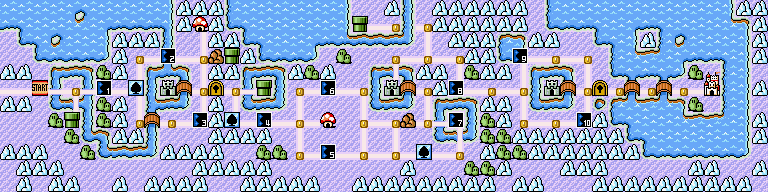
My vision of each planet's surface is a pointcrawl that resembles Mario 3.
 
Defeating the tyrants transforms each planet and removes hazards from neighboring worlds,
like in Mega Man X where defeating one boss makes another stage safer to navigate.

The problem with all these ideas is that they probably take too much preparatory work to set up. The Nutcracker Princess Campaign probably needs the least, just enough of an idea about what each kingdom and court is like, and a better concept on my part of what actually happens during a game session in this campaign. The Vaults of Azurth would be next; it would take quite a bit of map drawing to get started, and at least the start of the random tables that would populate the exhibition spaces and vendor stalls.

The Alchemical Planetary Romance would be a real labor of love. Doing it right would mean having adventuring sites and dungeons at least one of the planets, a notion of what the tyrant wants that would persuade them to abdicate rather being forced to fight to overthrow them, and plans for the interconnections between planets. Really, that's one that if I could ever do it right, I'd want to be sure to put it into a book, or perhaps a boxed set with cardboard playing mats to represent the planets and the villages and the castles. It would need art, and lots of it, images of each planet before and after it transformed, 16-bit pixel art and hand-drawn "concept art" to depict each world and monster and boss. It's such an oversized idea that it's absurd even to consider it, and yet I hope it's something I could have the time and resources to put together someday.

In the meantime, the Nutcracker Princess Campaign would probably benefit from a consistent player base, while the Vaults of Azurth would likely be the most fun in an open-table setting where different groups of players could compete to find the coolest stuff. It'd be fun to do something set in space, even if my current inspiration is a non-starter. Writing this was helpful, because it lets me see some commonalities across my current ideas. However, if these three are my only ideas for 5e gaming, then I might need to go back to the drawing board...