In some ways, the Forgotten Realms setting of contemporary
D&D is a very vanilla fantasy realm (and the Golarion of
Pathfinder is pretty much the same, except maybe more high fantasy and with slightly more fantasy types represented amongst its own "realms"). But in other ways, the setting of D&D is
weird.
The weirdest stuff is mostly the stuff WotC reserves as "product identity," the
non-open game content that lets them maintain their trademarks (or whatever). The beholder, the mindflayers, the slaad, the tanar'ri, the yuan'ti, the gith... You can see it in Tales of the Grotesque and Dungeonesque's
"Let's Read Mordenkainen's Tome of Foes" series, where, for example, you see
a "loving, good" elf god who damns his followers / children to unending torment via infinite reincarnation and nightly visions of elf-hell for the "sin" of wanting physical bodies and stable gender. (Yes, in D&D, the elven epitome of goodness is a vengeful genderqueer/non-binary entity who will never forgive the elves for wanting to be men and women. And somewhere, I'm sure, there are right-wing D&D fans who are deeply offended by how "progressive" they imagine this story to be.)
In my opinion, the stuff that seems "weirdest" in
D&D is the stuff that has no precedent in genre fiction. While "Appendix N literature" famously inspired a lot of the setting and mechanics of the original
D&D game, and Tolkien's writing is arguably
as big an influence on later
D&D as it is on
all post-Tolkien fantasy, there are some things that are basically unique to
D&D, or that only show up in literary fantasy
when the authors are modeling their books to be more like D&D. In particular, the weirdest stuff is the stuff that's to do with "the planes." It's not like D&D invented
the idea of traveling to "other worlds", but it's almost unique in terms of its detailed and well-documented interdimensional cosmos.
(I think D&D is also fairly unique in its insistence on an expansive polytheism of living, interventionist gods, but I don't plan to expand on that here.)
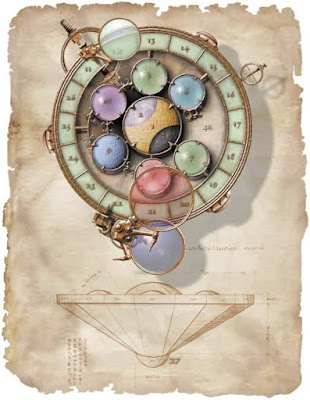 |
Fig. 1 - The Great Wheel from D&D 3.0 Manual of Planes
|
 |
Fig. 2 - The Outer Planes from D&D 3.0 Manual of Planes
|
I say it's
almost unique, because I can think of one literary source that has a fantasy cosmology that's not only as systematic and as rigorously cataloged as
D&D's, but that sort of mirrors the structure of
D&D's cosmology in some interesting ways. One fascinating thing about the similarities between these two interdimensional cosmoses is that I
don't think (although I could be wrong) that the similarity is the result of copying. As far as I know, this other cosmos was built up over time, as enterprising and/or obsessive authors insisted on taking idiosyncratic elements of fiction and turning them into the building blocks of an orderly, logical, systematic, internally consistent fictional universe.
I'm talking, of course, about the multiverse of DC Comics.
 |
Fig. 3 - Map of the Multiverse from DC's Multiversity
|
 |
Fig. 4 - Some worlds of the post-Convergence multiverse from DC's Convergence
|
 |
| Fig. 5 - More worlds of the mutiverse |
In both
D&D and DC, there is a core reality - "the Prime Material Plane" in
D&D and "Earth-1" in DC Comics - that is surrounded by the rest of the multiverse. In both cosmologies, that core reality floats around a bit like an island in some medium - called "the Astral Sea" in
D&D and "the Bleed" (apparently) in DC Comics - surrounded by other islands, some near, some far, and all organized in a fairly predictable way.
In
D&D there are two groups of "Inner Planes" - the Positive and Negative Energy Planes, and the Elemental Planes of Air, Earth, Fire, and Water. The Inner Planes are essentially made up of whatever form of matter/energy they're named for, and the planes themselves are supposed to be the ultimate source of each of those substances.
(In some settings, there are also a bunch of "demi-elemental" and "quasi-elemental" planes, but these are the core ones. In 5e, I believe that "the Feywild" and "the Shadowfell" have replaced the positive and negative energy planes, although I may be mistaken about the relationship between them.)
Although they aren't shown on the diagram above, DC Comics also has a number of elemental-type forces that are grouped logically as well. There are the various life forces represented by
"The Black",
"The Green", and
"The Red" (which are definitely actually planes), and there are the various color-emotion pairings of
"The Emotional Electromagnetic Spectrum" (which may exist just as elemental forces, rather than as places you can visit, although I won't be surprised if that changes in the future).
D&D also has "Outer Planes" which embody philosophies and ideologies the same way the "Inner Planes" embody various powers, forces, and energies.
D&D has an extensive list of "Outer Planes", eight perfectly embodying the possible combinations of Law/Neutrality/Chaos and Good/Neutral/Evil, plus another seven existing in between each adjacent pair of those, and one more embodying True Neutrality at the center of "The Great Wheel" formed by arraying those planes like directions on a compass. So, for example, you don't just have the perfectly Lawful Neutral plane "The Clockwork Nirvana of Mechanus", the perfectly Lawful Good plane "The Seven Mounting Heavens of Celestia", and the perfectly Neutral Good plane "The Blessed Fields of Elysium," you
also have "The Peaceable Kingdom of Arcadia" which exists halfway between Lawful Neutral and Lawful Good, and you have "The Twin Paradises of Bytopia" that exists halfway between Lawful Good and Neutral Good. In addition to being the multiversal font and source of each philosophy, each Outer Plane is the home of a race of beings who embody and defend the philosophy, and also serves as the afterlife for souls who followed that philosophy.
(That's right, in D&D, your afterlife isn't determined by the god you worship, but on the very precise moral philosophy your life followed. You and your spouse both worshiped a Lawful Good god and you were looking forward to your souls spending eternity together? Well tough shit, pal, because you two appreciated slightly different things about that god, so now you're going to Arcadia and they're off to Bytopia, and you'll never see each other again. Don't worry though, I'm sure that you and the accidentally-slightly-good worshipers of the Lawful Neutral clock god who also got separated from their
spouses for eternity will all get along just fine.)
DC has two sets of worlds that I see as analogous to the Outer Planes. The first analogy I thought of - the one that helped solidify my being convinced that the D&D and DC cosmologies are similar - is
"the 52 Earths". In addition to Earth-1, there are 51 other earths. None of them are as tightly tied to any single concept as the "alignment worlds" of D&D's Outer Planes, but most of them are "opposites" of Earth-1 in some way, or else they embody a particular time-period or aesthetic, which is quite similar in its ultimate effect. According to that multiversal map thingy DC made, there are also paired worlds that more similar to D&D's Outer Planes, including standing in an after-lifey-type relationship to the various earths. The most famous pair is "
Apokolips & New Genesis", but there's also
"Heaven & Hell",
"Dream & Nightmare", and a few more.
(I will confess, before continuing, that I have somewhat good knowledge of D&D's planes and their history, and more like a casual fan's knowledge of DC Comics and the storyline trajectories that led to the multiverse they have today. So if I may get some details wrong. My larger point is that these two fictional universes / franchises share some interesting similarities in terms of their fictional multiverse, and that those similarities are all the more interesting because they are pretty much entirely unlike how any other genre fiction imagines other dimensions. So if I get any details wrong, I'm sorry, but try not to let that make you lose sight of the larger point here, which is that these two universes are weird
and they are similar to each other in almost precisely the ways they are different
from everything else.)
Inner Planes - The Black, The Green, and The Red
DC's first set of Inner Planes are depicted as both places, kingdoms with parliaments and avatars, and types of life energy. I see them as roughly analogous to D&D's Positive Energy Plane and Negative Energy Plane. "The Black" is the source of death, rot, and decay; "The Green" is the source of plant life-energy; and "The Red" is the source of animal life. They were first introduced
as planes in New 52
Animal Man and
Swamp Thing (I think, although it's possible they were described earlier.)
Each plane, when it appears in the comics, is depicted as being a sort of endless panorama of life. "The Red" for example, which seems a bit like
Xor, is depicted as a ground made of meat, with rivers of blood and clouds of blood droplets, where internal organs grow like plants grow on Earth, and amalgams of every kind of animal life wander the plains. It's creepy, gross, utterly alien and utterly familiar, and it looks like an awesome place for a
D&D character to travel while I eat a salad or something to avoid thinking too much about my own tongue. The other two are similar, just, you know, for plants and death.
 |
| Fig. 6 - Animal Man traveled to The Red, where he was alternately portrayed as himself, an animalistic version of himself, a skeleton in a body made of blood gelatin aspic, and a walking mass of blood vessels. |
 |
Fig. 7 - The Black is like a much more visceral version of the usually bloodless Negative Energy Plane, while the Positive Energy Plane is sort of divided between The Green (which looks more or less like the Feywild) and The Red (which looks like Xor and/or David Cronenberg's vision of heaven.)
|
These planes were never DC's original plan for their characters.
They emerged over time from writers seeing multiple characters with
vaguely similar powers and deciding that those powers must emanate from a
common source. As humans, we notice patterns, and we crave order, and
when we apply logic to our own unruly, diverse storytelling traditions,
we are often tempted to impose order by systematizing, categorizing,
lumping things together and sorting them into orderly piles. It's almost
like entropy in reverse, and it follows the same times-arrow - once
done, it cannot be easily undone by future storytellers.
It's
like how the original Flash was just a man who could run fast. Later
versions of the Flash (and other super-fast people, of whom there are so
many they essentially have a character class, "speedster") - later
versions of the Flash aren't men who are able to run fast because the
ability resides inside them, they're men who can tap into a kind of
extradimensional energy that comes from its own "Inner Plane", the Speed
Force, which (fortunately) stands alone and apart from any additional
systematizing.
I'm of two minds about this
process. On the one hand, imposing a system can serve as a spur to
future creativity. Decide that all your heroes with animal-type powers
are drawing on a common source of power, call it "The Red", make it a
place, and suddenly you can go there, visualize new sights, have
adventures that would have been impossible before. But the system imposes limits
. Whatever logic there is to how "The Red" works means that some forms of animal superpower are now off
limits, because they would break rules that didn't exist before. And the system demands completion
. Which means that there are areas that demand
to be filled in, whether anyone has a good idea of what to fill them in with
or not. D&D's writers had a good idea of what Heaven should look
like, and a clear image of Elysium. In contrast, Bytopia mostly seems to
exist because it had
to. It's a check-box, pro forma afterlife, there because the logic of the system demanded that something
be there, and no one felt inspired enough to come up with anything better. And now that it is
there, we're stuck with it. Even if someone comes up with a brilliant,
mythologically-inspired vision of the LG/NG afterlife, they can only
write it into an official D&D product if they can still call
it "Bytopia" and still make it compatible with the handful of established facts about that
place.
 |
| Fig. 8 - Unfortunately, the logic of unlimited systematization means that in addition to the neat tripartite division between The Black, The Green, and The Red, there also exists The Clear, The Grey, The White, The Metal, The Melt, and The Divided. Fortunately, these seem to be mostly unused, just briefly mentioned. The Divided (which is like The Red, except for bacteria) looks pretty cool though. |
 |
| Fig. 9 - New 52 Earth-2 Green Lantern took a special class feature option and channels The Green instead of the green/will light of the Emotional Electromagnetic Spectrum. Here he is inside Earth-2's The Grey, which is associated with fungi and zombie Solomon Grundy and is different enough from The Black to justify its separate existence in the following way: ??? |
Inner Planes - The Emotional Electromagnetic Spectrum
DC's other "Inner Planes" are the color/emotion combinations that make up the Emotional Electromagnetic Spectrum. Red light is associated with anger, orange light with greed, yellow light with fear, green light with willpower, blue light with hope, indigo light with compassion, violet light with love, black light with death
(no, I don't understand this one), and white light with life. I see these as being analogous to
D&D's Elemental Planes. So, for example, just as The Elemental Plane of Fire is the ultimate source of all the fire in the Material Plane, and all the fire in the Material Plane is connected back to the Elemental Plane, both all green light and all emotional willpower have the same source in the Green/Will section of the Emotional Electromagnetic Spectrum.
I don't
think that these have ever been depicted as actual planes, that is, as actual
places someone could go. As far as I know, they're just portrayed as being types of energy - it's just that the same type of energy manifests as a particular emotion when it's being channeled through a living being, and as a color when it's just manifesting as visible light. I believe there's also an implication that if you
see enough of the right color of light, it will cause you to
feel the associated emotion.
(So far as I know, DC has never implied that someone feeling an emotion strongly enough causes them to spontaneously emit light!) Each color of light is directly channeled into our universe by giant lanterns.
(It's not clear to me if these lanterns are supposed to be the
originating source of the light - such that, if a lantern were destroyed, that color would cease to exist in the universe - or if the lanterns just channel the light into our universe from some extradimensional source. It's also not clear to me if someone built the lanterns, or if they just exist
because the colors exist and need
something to channel them.)
I'm not sure entire planes dominated by a single color-emotion pairing would make for very good comic-book adventure settings, but they might make pretty good destinations for planes-hopping
D&D adventures, especially for
occult planes-hopping
D&D adventures. They'd certainly provide a milieu for roleplaying being overtaken by emotion, and they'd make for a setting where players would frequently have to succeed saving throws vs bad decisions. Having these planes be dominated by color-emotion pairings feels suitably weird, moreso than color-only or emotion-only planes would be, and
at least as interesting as planes made up entirely of water or rock (as
Into the Odd points out "There's a reason people think of the City of Brass straight away when discussing the Plane of Fire.")
 |
Fig. 10 - The Emotional Electromagnetic Spectrum, and its representatives. Apparently, within the DC Universe, it's axiomatic that if there is a color of light, there is a lantern that projects it, and if there is a lantern projecting light, there are clerics Lantern Corps members channeling it. |
 |
| Fig. 11 - If anyone did visit the color-emotion pairing planes, I imagine it would be like visiting one of the color-coded alternate universes in Farscape 1x17 "Through the Looking Glass", where each plane is inimical to human life in an annoying but short-term survivable way. |
In small doses, systematizing can act as a spur to creativity. Deciding that the classic characters of Green Lantern, Sinestro, and Star Sapphire don't just coincidentally have similar
magic rings, that they have essentially identical
magical rings, just drawing on different power sources, and
that like Green Lantern, Sinestro and Star Sapphire need to feel certain emotions to make their rings work ... well, I don't know, perhaps it inspires storylines or ways for the characters to fight that you couldn't have written before. Maybe it makes you want to come up with other color-emotion pairings for other characters to use. Just like the idea that Kryptonite that is always drawn as green
makes Superman weak, perhaps it's because that's "green Kryprtonite", and perhaps there are other
colors of Kryptonite that affect him in different ways.
There are two pitfalls here though, and they both come from systematizing too much. The first is this desire to exhaust all possibilities
. To list out every emotion-color pairing, to describe an entire rainbow of Kryptonite colors, to catalog every possible demi- and para- and pseudo- elemental plane. For some of those, the exercise will spur your creativity, but for others, you're just not going to have any good ideas, and so you'll make placeholders, and they'll be bland, and the logic of preserving trademarks and monetizing intellectual properties will mean that you can never get rid of them. The second danger is the allure of creating a grand unified theory
. Rather than forcing yourself to create too much, you combine similar things until everything's the same. It might be interesting to think that all the animal heroes get their powers from The Red, or all the plant villains get their powers from The Green ... right up until it starts meaning that you're just giving them the same powers because they come from same source. Worse is when you decide that maybe the green/will light is connected to The Green is somehow associated with green Kryptonite is secretly related to Green Arrow just because he has the word "green" in his name ... you connect and combine until eventually everything becomes identical, becomes bland. Part of the charm and weirdness of old comics is that everything's idiosyncratic, everything's unique. Like Max Weber once observed, out-of-control systematization is a one-way process, it locks us in an iron cage of rationalization, it leeches the magic out of everything.
Outer Planes - The 52 Earths
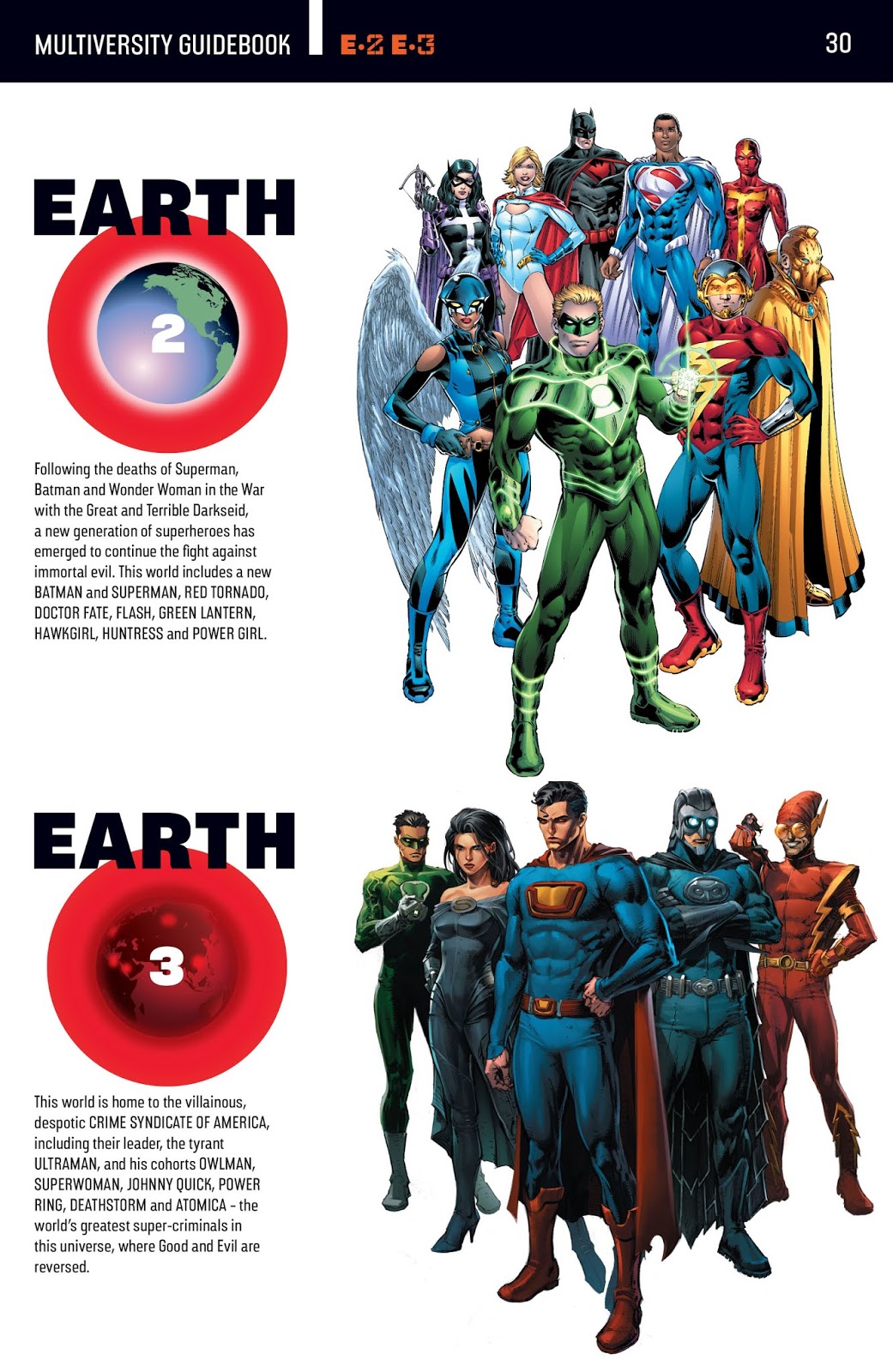
The first set of DC's "Outer Planes" are its many alternate earths. Earth-1 is the home of DC's Silver Age universe. Earth-2 has their Golden Age universe, and having it allowed the characters there to age, get married, have children, pass on their legacy to successors they mentored. For characters like the Green Lantern and the Flash, having Earth-2 meant that the Alan Scott and Jay Garrick versions got to still exist, while for characters like Batman and Superman, it mostly meant that they got to become elderly. Earth-3 is like
Star Trek's Mirror Universe, it's a place where (officially) all of morality is inverted. In practice, this means it's a crapsack world full of petty, quarrelsome people ruled over by a Crime Syndicate of Ultra-man, Super-woman, and Owl-man (evil Mirror versions of Superman, Wonder Woman, and Batman.) Earth-5, also called Earth-S is home to
Captain Marvel Shazam, and Earth-10, also called Earth-X, is an Earth where the Nazis won World War II and heroes like Black Condor and Doll Man fight
different evil versions of DC heroes like Over-Man (Superman) and Blitzkrieg (Flash).
More recently, DC decided to set a hard limit on how many alternate earths there are, and assigned numbers and specific identities to most of them. I didn't really think the original
52 marketing event was all that successful, but somehow DC decided the number 52 is their brand identity, so the next time they rewrote their own continuity, they called it
New 52, and when they decided to systematize their alternate earths, they decided there are 52 of them. Go figure. So now Bizarro World isn't just some weird planet in space, it's Earth-29. There's are other opposite-type worlds, like the earth where everyone's gender is different than on Earth-1, and there are lots of other era-type worlds, like a Victorian earth, a Wild West earth, a pirate earth, etc. And they all have their own numbers and encyclopedia entries.
(I think there are even two different earths populated by parodies of Marvel Comics characters, and two different earths full of talking animals where the Superman doppelganger is a rabbit. Why two of each? For the following excellent reason: ???)
 |
| Fig. 12 - The protagonists of Earth-2 and Earth-3, post New 52, from Multiversity |
 |
| Fig. 13 - Protagonists from Earth-11 and Earth-12. |
As I understand it, most of these "other earths" came about because DC Comics kept buying up other comic book companies and their characters. In some cases, they just immediately brought the new characters over into the main DC universe, but for whatever reason, in other cases, they kept the characters in their own separate fictional "universe" within the larger DC multiverse. Earth 5, for example is pretty much just the Fawcett Comics universe, and Earth X is pretty much just Quality Comics.
The other big source of "other earths" seems to be DC's own
Elseworlds stories. I think these are pretty similar to Marvel's
What If? stories, and like Marvel, DC seems to have decided that these aren't just non-continuity stories told using re-imaginings of their characters; they're
alternate universe continuity stories told using
alternate universe versions of their characters.
(It also seems like they kept changing their minds a lot, bringing things together only to blow them back apart, only to bring them back together, only to separate them yet again.)
 |
| Fig. 14 - Protagonists from Earth-18 and Earth-19. |
 |
Fig. 15 - Protagonists from Superman: Red Sun Earth-30. |
This is what I mean when I say the D&D
and DC cosmologies are weird
. Yes, Star Trek
has a Mirror Universe, but that's just it, it has a
Mirror Universe, it doesn't have four dozen of them. Captain Kirk once found a planet where a human had recreated the Nazi aesthetics and regime in spaaace
, and when he passed through the Guardian of Forever, he briefly accidentally changed history so that his own earth was dominated by Nazis ... but he never found an entire alternate dimension where an alternate earth was being conquered by Nazis forever (and where, I guess, there would be a Nazi planet Vulcan, and a Nazi Klingon homeworld, etc). Countless religions imagine some kind of positive and negative afterlives, but none of them imagine seventeen
afterlives, each coded to very fine-grained distinctions between neighboring moral philosophies, and certainly none of them imagine that each afterlife is not just a place, but a source of its own moral philosophy, that radiates, for example, a philosophy exactly halfway between Lawful-Good and Neutral-Good-ness across everything the same way the sun radiates sunlight onto the earth. Basically no other fantasy that's not directly inspired by D&D's or DC's cosmology spontaneously arrived at a similar vision of other dimensions. Which, I guess, is part of why it's so fascinating that the two are so similar to each other, especially since, as far as I know, neither company was consciously trying to imitate the other.
Outer Planes - New Genesis, Apokolips, etc
DC's other "Outer Planes" are mostly similar to
D&D's. There's the pairing of Heaven and Hell, the Christian afterlives, Skyland and Tartarus, which I guess are supposed to be the ancient Greek afterlives, and New Genesis and Apokolips, which came from a Jack Kirby miniseries, and have gained in importance over time. I think when he first wrote them, Kirby intended New Genesis and Apokolips to be alien planets located in normal space. Since then, they've gotten a promotion. Just like Bizarro World stopped being
just a planet and got turned into Earth-29, New Genesis and Apokolips stopped being
just alien planets hosting allegorical battles between good-ish and evil aliens and started being divine dimensions equivalent to Heaven and Hell themselves and host to
literal battles between
the pure physical embodiment of good and evil.
 |
| Fig. 16 - Jack Kirby's New Genesis. |
 |
| Fig. 17 - Jack Kirby's Apokolips |
I mean no disrespect to Jack Kirby when I say that his original limited series had a place in the milieu of the 1960s and 70s, where its aesthetics fit in with psychedelia and its plot resonated with the counter-culture's war with the establishment, and that perhaps characters with names like High Father, Mother Box, Glorious Godfrey, and Granny Goodness are not necessarily nearly as compatible with contemporary sensibilities.
But this is the nature of comic book publishing. Nothing is allowed to simply exist in its original form. Every good story must be re-told and re-told and re-told until it becomes unbearable in its repetition. Not even retold. The same events must happen to the same characters who remember it happening to them last time over and over and over again. Jean Grey must become the Phoenix and die and be reborn and become the Phoenix and die and be reborn and become the Phoenix and die and be reborn. Kingpin must be dethroned and work his way back to the top and be dethroned and work his way back to the top and be dethroned and work his way back to the top. Superman must die fighting Doomsday and be resurrected and die fighting Doomsday and be resurrected and die fighting Doomsday. Darkseid must invade the earth and be repelled and invade the earth and be repelled and invade the earth and be repelled. We demand that our favorite characters be damned to the fates of Prometheus and Sisyphus.
Bonus Cosmology - The Dark Multiverse
When you consider how many of the 52 earths are full of "evil doppelgangers" for DC's superheroes, it seems almost redundant to have an entire extra multiverse full of
even more evil doppelgangers, but here we are. The Dark Multiverse, I am given to understand, is entirely, ontologically evil in a way that even Earth-3 and Earth-X aren't.
(I'm curious to know about the what the Dark Multiverse counterparts of the regular multiverses "dark counterparts" - is the Dark Multiverse version of Earth-3 one of the few good places? Or is it even more evil
than the rest of the Dark Multiverse? What about their version of Apokolips or Hell?)
 |
| Fig. 18 - The Dark Multiverse is sometimes depicted with a color-inverted version of DC's official multiverse map. Apparently it was first introduced though, as just being the black underside of the map. |
The "Outer Planes" of the Dark Multiverse are designated by a negative sign. This would work really well if DC didn't already use hyphens in their universe names. So like, "Earth -2" would be more instantly identifiable as being part of the Dark Multiverse if DC usually wrote "Earth 2" instead of "Earth-2".
 |
| Fig. 19 - Apparently everyone in the Dark Multiverse is Batman? |
 |
| Fig. 20 - Also, Galactus is there for some reason. Also also, he's dead. |
Bonus Systematization - Seanan McGuire's "Every Heart a Doorway" series
Seanan McGuire's "Every Heart a Doorway" and its companion novellas do something similar to
D&D and DC by
applying systematization to the fantasy worlds of classic portal-fantasy fiction. McGuire imagines that events like Dorothy travelling to Oz or the the Pevensie children traveling to Narnia happen with some frequency, and that the children who come back from trips to fantasy worlds need group therapy and to live in a special asylum to recover from their journeys and readjust to living in the real world.
So, obviously, McGuire is doing something a bit postmodern and metafictional, as Daryl Gregory does in "We Are All Completely Fine" where the survivors of common horror-movie plots form a support group to cope with their shared traumas. Most stories that have a portal to another world have
one portal to
one other world; McGuire concatenates dozens of returners from dozens of portals to dozens of worlds, and puts them in conversation with each other. And the
other thing she's doing, is systematizing, in exactly the same way that
D&D and DC Comics do. McGuire has her characters develop a typology of worlds that sounds suspiciously like D&D's alignment chart. The two "cardinal directions" in the array of worlds are the axis of Virtue vs Wickedness and the axis of Logic vs Nonsense. Or, as Gary Gygax called the same ideas, Good vs Evil and Law vs Chaos. The one big difference here is that instead of imagining all her "Outer Planes" as equidistant from the earth in a Great Wheel as Gygax does, she allows that they may be closer to or further from the earth along their axes. (Although in practice, nearly every character she talks about visited a "High Nonsense" or "High Logic" world, so the distinction is mostly academic, and also mostly a way to talk about the dichotomies without referencing neutrality.)
 |
| Fig. 21 - Tor.com commissioned a map of portal-fantasy story worlds that uses McGuire's terminology to systematize a whole host of fiction. |
Bonus Bonus
Because I am slow, in between when I started writing this and when I actually posted it,
io9 wrote about weird planes in Marvel and DC comics. I weirdly feel like I got scooped.
There's a whole cavalcade of different dimensions I didn't mention in this post, but the thing is, most of them are idiosyncratic. They're unique, they stand alone and have no relationship to the other planes out there. You enter each one in a different way. Want to go to the Mirror Dimension? You'll need a mirror and a special ray-gun. Want to go to DC's Microverse or Marvel's Quantum Realm? Just shrink real small. Trapped in the Phantom Zone or Negative Zone? There's some special machine you'll need access to, plus time will have passed differently for you there. Also there's no way to travel from one of these places to any other.
These "weird" dimensions are actually more like
Pathfinder's revisions to the
D&D plane-scape. They're planes that exist pre-systematization. Each one was invented by a different creator, to serve as an adventuring site for a different hero. Each one has its own method of ingress and egress. None of them are connected. They're certainly not laid out like coordinates on a grid. Looking over this list reminds me what's unique about
D&D's multiverse, and about the parts of the DC multiverse I've talked about. Most other fictional alternate dimensions are stand-alones, they're messy, disorganized, almost organic, because they simply accrete facts over time as people write about them. What's unique about
D&D's and DC's "multiverses" is that they have a logical system underlying them. They were (or appear to be) created whole-cloth, designed rather than accumulated. It is actually fairly unique for them to not be idiosyncratic.