In my first post in this series, I introduced an adventure that I tried and failed to write a few years ago - "The Night Garden at the Vanishing Oasis" - and I talked about some of the materials that provided me with inspiration the first time around.
This time I want to talk about what went wrong the first time I tried writing this adventure. Part of what went wrong, of course, were various personal failings on my part - procrastination, distraction, moving on to a new thing before the old thing is finished, etc, etc. But I also think I was stymied by some of the decisions I made early on about how to go about structuring an adventure, decisions that made the design process harder than it needed to be and possibly contributed to me feeling like I didn't know how to finish it.
When I sat down to try to write this adventure the first time, I was drawing on the models I had available then for what an adventure in old-school D&D should look like. (Remember, I wasn't trying to invent a totally new thing. I was trying to make a new example of an existing type of thing. So it still makes sense that I would look to other examples to see what that kind of thing is supposed to look like.)
While I was probably drawing on the collective teachings of the OSR blogosphere of the time, I know that I was also intentionally basing the structure on the 10 minute outdoor hexcrawl from Lesserton & Mor, the advice about strict time records and strict movement records from The God That Crawls, and some of the ideas about what "weirdness" in an adventure looks like from The Monolith Beyond Space and Time.
One reason that I feel more better able to attempt this project again today is that I now have a lot more models, a lot more existing examples, to draw from when deciding what an outdoor adventure site ought to look like. Instead of hoping that the handful of things I know about are the best or only way to do things, I can think about my goals, compare several options, and decide what I think will work best for my purposes.
Today, I don't think the models I picked back then were really the right choice. I still like Lesserton & Mor, but it's meant to involve pretty open-ended ruin crawling over the course of multiple expeditions. It's way too big and way too sparse compared to what a superbloom oasis should probably be like. The other two titles I was critical of even at the time, but it's obvious to me now that back then I was influenced by their claims about the "right" way to measure space and time in a game, and the techniques available to show that a place is both unreal and dangerous.
(Something interesting can happen when people, perhaps especially kids, try to create something by following a model when they don't actually have enough information about the model. Most often, you get something incomplete, what you might call a cargo cult game if you were feeling uncharitable. But presumably, you sometimes get something innovative, if the game maker can recognize the gaps in their existing knowledge and fill them in with invention and creativity, something like Calvinball, except, you know, real.)
(As a kid, I knew that D&D and other games like it existed and had combat, but I had no idea how it should work. I assumed combatants should have roughly 60 to 100 hit points - in retrospect, I'd guess my kid self unconsciously picked a number range that was familiar from the grades you get at school. I also thought combat should somehow involve hit locations. Beyond that I didn't know what to do though, so I was left with something partial and nonfunctional.)
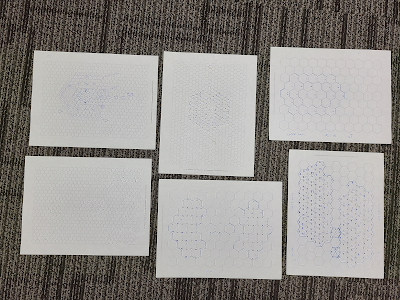
Here was the adventure I'd planned - a giant team of zero-level characters is assigned to go pick flowers that only appear at a certain oasis after a super heavy rainfall, and only bloom at night. You have three set encounters on the road to the oasis, then run into bandits waiting to ambush you just as you arrive, then finally get to an oasis made up of 120-yard hexes (aka, 10-minute hexes). You arrive at noon, unless you spent too long on the earlier encounters, and have until 9pm to explore until nightfall. The flowers bloom at midnight and can be harvested until 6am.
Also the very first encounter is a different garden with a big "Do Not Enter" sign out front, where magical gun-flowers are growing, and if you take them, the GM should track everything you kill, because their ghosts will come back to haunt and attack you at 1am, the "Witching Hour". The GM is also of course tracking the time in 10-minute increments from, at a minimum, noon on the first day to 6am on the second. Also the GM should track and impose penalties for lack of sleep and dehydration. Also also, you have to harvest the flowers, because the guy back in town who "assigned" you to go pick them "knows" how many to expect you to bring back, lest you get tempted to do something between midnight and 6am besides say "I harvest a flower" over and over whenever you're not fighting something that's ambushed you.
The oasis is divided into four main sections, plus the Central Basin. You enter via the Wildflower Garden. To one side is the Succulent Garden, which has friendly plants but more dangerous wildlife, and the other side has the Cactus Garden, with dangerous plants but basically harmless animals. The back, which is more optional, since you don't need to pass through it to get to any of your goals, has the Rock Garden.
I was aiming for a mix of prosaic reality and outrageous unreality, but in terms of what I actually wrote, there was probably a bit too much of the mundane, and not enough variation in tone. Worse, the "unreal" things I wrote seem less like real interactive encounters and more like exercises in frustration. There's the giant unkillable sandworm. The unkillable and ever-multiplying puppy snails. The unkillable ghost who wants to steal your stuff. The mirage that lets you find whatever you want, but it vanishes as soon as you leave the hex. Plus the mandatory ambush by bandits, and the likely overwhelming mandatory ambush by ghosts if you were foolish enough to dare kill anything with the super cool magic guns in a game whose goal is to kill things and take their stuff.

Too Much Simulationism, Not Enough Gameism
At the risk of oversimplifying a rather elaborate of game design preferences, let me loosely define simulationsim as a preference for game mechanics that at least appear to recreate real-world conditions within the game world. Gameism is a preference for mechanics that are more abstracted. So measuring distance in feet or miles, counting time in minutes and hours is more simulationy, measuring distance in hexes or point-crawl-nodes, counting time in turns or "watches" is more gamey.
We can imagine two archetypal endpoints, and a continuum of mechanics between them. I tend to think of mechanics that are more "zoomed-out" and more indivisible, that is, focused on bigger distances and longer units of time, without allowing for incomplete travel or partial distances, as being more game-like. Mechanics that measure things on a smaller scale, that break out the rulers and the pocket calculators for partial measurements, that are more "zoomed in" and more granular, I think of those as being more simulation-like.
Importantly, I would say that Gygaxian strict records, for time or anything else, are more simulationy. My own preference, personally, is for things to be more gamey. So when I look back on my previous plan, to track time of day in 10-minute turns, with specific weather effects at specific hour markers, that now strikes me as being too simulationist. I want to unshackle the adventure from a strict one-day time frame, allow more fictional time to pass, and reinforce the desired dreamlike or hallucinatory aesthetic by making the passage of time more abstract and less tied to a precise clock.
Likewise, my map with its hundred-plus hexes, most of which were empty, both because I hadn't finished keying them, and because I think I thought each interesting hex ought to have a buffer around it, now seems to me like it would benefit from becoming more gameist. A point crawl map would allow for the desired "travel time" between each site, it would allow each site to be interesting, and it would almost certainly reduce the total number of sites that need to be numbered and keyed. And again, by zooming out from strict, small hexes to larger, indeterminately sized point-crawl-nodes, I can allow the fictional space to expand a bit, rather than feeling so cramped and claustrophobic.
Too Much Railroad, Not Enough Sandbox
While my original plan for this adventure was not strictly linear, there were some major guardrails thrown up to keep players "on track." There was a small linear section leading to the oasis, and a couple unavoidable encounters at the beginning and end of that section. But the biggest obstacle to player freedom was framing the whole thing as a mission on a very tight time schedule. Because the characters came to the oasis with a specific objective that they could only achieve at a specific time, the whole adventure was set up so that there was a "right" thing for the players to do - namely to go straight to the flowers they were after and camp out until nightfall - and plenty of punishments if they chose to do the "wrong" thing and actually explore the big, interesting environment surrounding the one little patch of ground they were "supposed" to care about.
So like, obviously actually playing the game of D&D in a way that's any fun whatsoever requires the players to act with less than military precision and discipline. March in, secure the perimeter of the site, gather the resources, march out - tactically smart, I guess, but deadly boring, and it provides no real opportunity for players to make meaningful choices, except to follow orders like a soldier and succeed, or act like you're playing a game and get punished for it. I'll say more about this in the next section, but for whatever reason, at the time, I felt like I was following a zeitgeist that said that adventuring should be a choice, and it should be the wrong choice, because it's dangerous and irrational, and therefore adventures should be set up to reinforce to players that they're making a mistake by adventuring.
To my mind, one of the best ways to make meaningful choices is when there's no obviously right answer. There are alternatives, each with benefits and drawbacks. But if there's one option that's just objectively better than the others, selecting that option is a choice, maybe, but it's not a meaningful choice. Recognizing that option for what it is might require skill and good judgement, but once you know it and see it, doing the thing that's right and easy is more like a foregone conclusion than an actual decision. (Note that I think this is as true of character "building" options as it is of the choices you make once the game begins.)
So in revising the adventure, I want to give the players more choices to make, and I want the those choices to be about how to explore the site, not whether to explore it or stay on-mission. Instead of set pathway leading to the entrance, there will just be an entrance, and there will be no high-stakes mandatory encounters at that entrance. I might still like to have some effects that are tied to the weather and time of day - but those can be random encounters rather than something the GM needs to devote a lot of effort to tracking. There will still be a special garden at the heart of the oasis, but no extremely strict schedule the players need to follow in order to reach it without arriving too early or too late. And the garden will only be one reason, out several to explore the site. There should be plenty more to see.
Too Much Negadungeon, Not Enough Fun Dungeon
There's a strain of Foucauldian discipline to the way that a lot of mid-OSR scenesters talked about "the right way to play" on their blogs and on Google Plus. It was all about going slow and steady, always checking for traps, always pausing to listen at doors, always searching for secret passages and hidden treasures, constantly checking and re-checking for any sign of danger, producing a map at least as accurate as the GM's while eking a slow path through the dungeon. I don't know how often people actually played like that, but enough people were vocal enough to make it sound like it was an expectation. This was dungeoneering as a player skill, and the apotheosis of this mindset, I think, is the so-called negadungeon, the dungeon that forces you to play in the preferred style, because if you don't, it will kill your character.
I don't think I was consciously trying to make this adventure site into a negadungeon when I first started writing it, but I was consciously influenced by the conversation around negadungeons and the way that they (according to some people, anyway) represented the absolute pinnacle of correct design for an adventure meant to challenge the players rather than the characters. I've made a small reading list of my favorite posts on the topic, which I'm not going to individually summarize, but you can read if you'd like. Essentially a negadungeon is a place that's not for you - everything is dangerous, the rewards aren't worth it, and every mistake you make compounds to make the further sections even harder than the previous.
There can potentially be interesting choices between something that's right and difficult and something that's wrong and easy, but usually only if you're talking about a moral dilemma. It might be better to call those options good and difficult and bad and easy, instead. That dilemma is a great motivator in literature, everything from Felicity Learns a Lesson to "The Ones Who Walk Away From Omalas". But stripped of its moral dimension, I would say that this dilemma becomes less compelling as the basis for making decisions in a roleplaying game. Right and difficult has its place even when right just means correct and not virtuous - we admire artists, athletes, and craftspeople who can do things well that are difficult to do at all, and games like chess have correct strategies that are hard to learn but result in winning the game because you've played it well.
If you as the GM adopt a strict, mid-OSR mindset that players should choose between playing the game in a way that's right and boring or wrong and fun, first, you can expect your players to dispute your definitions of right and wrong in this context, (roleplaying is not that kind of game, or at least not indisputably so) and second, you can expect almost everyone involved to get very frustrated very quickly. Even Gary hated how Gary's GMing taught Gary's players to play.
There's a reason why Old School authors beg you to bring along as many mercenaries and baggage carriers as you can afford, why Dungeon Crawl Classics sends you in with three back-up characters trailing behind you, and why every official edition since 2e has given starting characters the maximum hit point from their starting Hit Dice - it's because people want to play the game in a way that's fun without having to stop to make up new characters every 15 minutes. They're different solutions, but they all accept the same basic premise, people want to have fun more than they want to be painstakingly cautious.
Here's the thing. When I was talking about decision-making, earlier, I noted that if there's just one obviously right choice and a bunch of obviously wrong ones, then it's not a very meaningful decision at all. It doesn't actually require a lot of skill to run through a rote laundry list of standard precautions before taking each new 10' movement - just a willingness to endure hours of tedium. And if everything in the dungeon is a deadly trap, if everything you interact with punishes you for interacting with it, then it doesn't take much skill to just not touch anything - again, just a willingness to hear a lot of room descriptions and never ask for more detail or engage with the environment except to wander through it like a museum where everything is protected by velvet ropes.
So when I remake this adventure, I want it to be less negadungeony. I want players to explore the oasis, and I want them to be glad they explored it. In addition to not having a "script" of instructions from a patron, exhorting them to go straight to the MacGuffin Garden without poking around off the beaten path, I don't want the rest of the oasis to so dangerous and so unrewarding that you wish you hadn't bothered investigating anything. Obviously it's a balancing act, because there need to be monsters, hazards, and other dangers, but there should be worthwhile treasures and rewards as well, and the mix needs to be weighted enough toward the good stuff that the players want to continue trying to figure things out, even though their characters sometimes suffer for it. The gardens should be full of wonders, and while those should sometimes be deadly too, they should remain enticing rather than forbidding.
The point of all this critique isn't to beat myself up about what I wrote before, it's to take stock of my mistakes so that I can do a better job the next time. So next time, in part 3, let's start writing!


