Showing posts with label darkness. Show all posts

Thursday, December 26, 2024

Santicorn 2024 - Effects of Primal Darkness

For Secret Santicorn 2024, Vile Cult of Shapes asked for "effects of prolonged exposure of Primal Darkness on various surface dwelling species."
 
I decided to write two sets of results. One for player characters, and one for NPC hirelings, henchmen, and so forth. I leave it to the referee and players to decide what counts as Primal Darkness in their game, and what sets it apart from normal darkness, although I think if you get trapped underground at the end of an adventure, that should certainly qualify.
 
 
Some characters gain power from the darkness...
  
When a PLAYER CHARACTER is exposed to Primal Darkness, ROLL on the table below. On the first exposure, roll d4; on the second, d6; and so on, up to a maximum of d20. If you roll a result you've received before, immediately roll again using the next highest dice, and add +1 to each future roll.
 
1 Your skin, hair, and eyes become unnaturally bleached and pale. You look haunted and unsettling.
 
2 You become cold-blooded. Your skin is cold to the touch, and you always look sallow and wet. You no longer suffer any ill effects from the weather or the temperature of your environment.
 
3 You now understand undercommon, the trade language used throughout the underworld. You speak with a native's fluency.
 
4 You now revere one of the gods of the underworld. Any previous faith has been replaced by this heretical new piety. You are eager to acquire scriptures, icons, and other tokens of your newfound religion.
 
5 You begin to "hear" the emotions of others as whispers in your mind. This provides insight during negotiations. And thinking beings can no longer hide from or surprise you.
 
6 You receive a vision from the underworld. With absolute certainty, you know the location of a valuable treasure room, and a path d6+6 rooms long that leads there, starting from a previously unsuspected secret door in a dungeon room your party has already explored and can access easily.
 
7 You can no longer perceive colors, only shades of grey. But you can also see a faint aura glowing from any cursed or poisoned objects, emanating from unnatural creatures in ways that suggest the nature of their powers.
 
8 You grow gills and can breathe underwater. You can dive and swim as easily as you can walk. You need twice as much water each day as before, and suffer from exhaustion if you don't get it.
 
9 You now understand Aklo, the Deep Tongue, the language of underworld aberrations. You can eavesdrop on the servants of the deep, but are now vulnerable to their lords' commands, without the protection of your previous ignorance.
 
10 Hideous and grotesque sights no longer phase or disturb you. You can meet the gaze of creatures whose sight turns others to stone with equanimity, stare into the eyes of tyrants who suborn others as thralls without blinking. But the sight of your own reflection - in mirrors, glass, even water - turns you away in terror, as a walking corpse flees from a cross.
 
11 You have acquired a "pet" down below. It serves you as a familiar serves a spellcaster, but its true loyalty is one of the great powers of the deep, and it is always watching. The referee will decide your pet's form; its appearance is related to the entity it serves.
 
12 A physical third eye opens in your forehead. You communicate by broadcasting your thoughts, no longer deigning to speak aloud. You understand the hidden logic of underworld passageways. You can spot its secret doors and are no longer confused by its impossible architectural.
 
13 You have been crippled by the underworld. You are now an NPC under the referee's control, and you become an outcast in town, living in a hovel in the worst district. You survive by selling gossip and portents, rumors about what has happened recently in the underworld and eerily accurate predictions about what will happen next. Occasionally, you can do more, identifying or fixing or fabricating useful items - if you have the right material to work with.
 
14 You cannot bear to be outside in daytime sunlight, and you must stand apart and separate from any group carrying a torch or lantern. If you approach too close to fire, it burns you as though you were touching it.
 
15 Your hair and nails fall out. Your fingers and toes elongate; you grow webbing between them, and fins on your joints. Salt wounds you like acid, and any damage caused by heat is doubled for you.
 
16 You no longer understand common language of the overworld. Its words sound like discordant gibberish; the noise of it hurts your ears.
 
17 You can no longer be healed by the servants of the surface gods. You are an unclean thing in their eyes, and their faithful aspire to smite you. Holy things are deconsecrated by your presence. Animals shun you. 
 
18 A new eye appears in the palm of each hand and your normal eyes wither away. You can "see" the presence of other thinking minds, even in the dark and through weak barriers. You always know the way to the nearest exit to the surface. You cannot bear to hold things in your hands for long.
 
19 You are blessed by one of the great powers that dwell beneath. You gain one level. You know with certainty who your patron is, and what favor they want in return for the power they've bestowed. You know you will die if you don't complete the task they've given you.

20 You are lost to the underworld. You are now an NPC under the referee's control, and you become implacable enemy of your former friends, determined to trap them down with you in the dark, and to bring ruin to the dwellers above.
 
 
... and some are destroyed by it.
 
When an NPC COMPANION OR ASSISTANT is exposed to Primal Darkness, first ROLL MORALE. Being lost in dark is traumatizing, and even loyal friends may abandon the player characters after such an experience. 
 
Then, if the NPC is willing to continue adventuring, ROLL D10 on the table below. The referee should make this roll in secret. In all cases, the players will not know the effect of the darkness until it is revealed as a result of play during their next excursion. The NPC cannot explain their own condition to others.

1 They gain a level, making them stronger, and possibly unlocking new abilities and talents.
 
2 If they are exposed to darkness, even normal darkness, they need to check morale at the end of the session.
 
3 They are miraculously unaffected by their ordeal.
 
4 Whenever they're exposed to darkness, even normal darkness, they begin screaming in terror, inconsolable, until the light returns.

5 They have developed an all-consuming obsession. They spend all their downtime on it, and will interact with anything related to it while adventuring. If Lawful, they are obsessed with shrines and prayers to underworld deities. If Neutral, they self-medicate with any intoxicating substances they can find. If Chaotic, they're addicted to gambling, and spend all their money on games of chance.
 
6 The next time they're exposed to darkness, they vanish into the underworld, and are never seen again.
 
7 They are driven to protect others from danger. Whenever a player character would fail a saving throw, or receive a critical hit, or take lethal damage, they will interpose themselves and take the effects on themselves instead.

8 Whenever they're exposed to darkness, or all the player characters are asleep, they will steal a valuable item a player character they're closest to. The character won't discover the loss until the start of their next adventuring session, unless they reach for the item in a moment of need. 
 
9 They are paralyzed by the sight of violence. They can no longer fight or even defend themselves. They are helpless in combat, and though they may hold a weapon, they cannot use it.
 
10 Whenever they're exposed to darkness, or all the player characters are asleep, or they're alone with only one character, they will attack with murderous intent. (If this betrayal seems unimaginable, they have instead been replaced by a Doppelganger, and this is the moment of revelation. The real NPC remains a captive somewhere in the underworld, waiting to be rescued...)


And please check out A Swamp in Space to see "Gifts for the Adventurer in Your Life" - which wr3cking8a11 wrote in response to my own Secret Santicorn request!
 
You can also take a look at "Surreal Science Fantasy Adventure Seeds & More" - which Vile Cult of Shapes wrote for Kirt Dankmeyer of Orange Subterfugacious Raccoon.
 
Thanks to Archon's Court for organizing this year's exchange!

Thursday, November 7, 2019

5e - Alternatives to Darkvision

Darkvision is fairly common among the character races in D&D 5e.

Dwarves have it, elves have it, gnomes have it, half-elves and half-orcs have it, and so do tieflings. Only humans, halflings, and dragonborn don't, at least among the races in the Player's Handbook.

Open up Volo's Guide to Monsters, and you'll find darkvision among aasimar and tabaxi, among all the monstrous races available for player characters - bugbears, goblins, hobgoblins, kobolds, orcs, and yuan-ti - along with a few more who don't, like goliaths and tritons.

Because almost every species has darkvision, it doesn't end up having much effect in play. Being able to see in the dark doesn't make you feel special, and can't become a key facet of your character's personality, if everyone else can do the same. Likewise, darvision never offers a character the chance to reveal hidden information none of their party members can discover if everyone knows that information by default.

So it would be more interesting, I think, from the standpoint of both characterization and information gathering, if different characters had a variety of different abilities, instead of all having the same one. It makes sense that Underdark natives - drow, duergar, svirfneblin - might have true darkvision, but this ability will feel more special if they're the only ones. I would also for sure let them see right through magical darkness.

I've made a list of some possible replacements. I've assigned them based on species, but you could also roll the dice, or just pick one you like. After the list, I have some thoughts about what it means for 5e to be designed so that so many player characters end up with darkvision. You could also add any of these abilities to a magic lantern or to a pair of glasses, like Luna Lovegood's spectra-specs. You can't really do that with darkvision, since every lantern already grants the ability to see in the dark. (Although I do deeply love The Manse's idea - orcs can see in the dark because their eyes glow red, and you can make a lantern by filling a glass jar with orc eyes.)

If you add to the list, make sure not to include things like "knows true north" or "can accurately guess distances" or "can count all the coins in a hoard on sight". Those might be superpowers in real life, but most GMs regularly assume that all player characters can do all of those things; it's ingrained in the way we share information with players. Offering those as special abilities is either going to be a cheat to those players when everyone else gets the same information anyway, or its going to impoverish your game by removing several common ways of communicating about the game world.

The senses listed below could be "always on" or they could require concentration to use. Some of these senses more-or-less replicate the effect of a spell. If that bothers you, you could make it take as long as a ritual to use effectively. You could also rule that some of these senses only work in total darkness, giving the players and incentive to douse the lights. If you don't like any of these options, you could also remove darkvision and replace it with a language, or with another proficiency.
 
image from Spelunky
ALTERNATIVES TO DARKVISION

Hill Dwarves - Gold Sense
Some hill dwarves possess a "gold scent" - they can literally smell the presence of gold, and the greater the concentration, the stronger the smell. They can tell when they're in the immediate presence of gold, and are drawn to the largest supply in the area - unless that's already on their person! (This one is adapted from DCC.)

Others possess a "gold sight" that lets them see gold glowing with a warm yellow light. A single gold coin gives off less light than a candle, but a small cache will shine like a torch, and a hoard like the noonday sun.

Mountain Dwarves - Trap Sense
Raised in labyrinthine halls amidst every available architectural trick and travail, mountain dwarves have an innate sense for building features intended to deceive or deal harm. In any built environment, they'll notice when they're in the presence of a "trick" or "trap" although they won't automatically be able to identify the nature of the hazard.
(Yes, "find traps" is a 2nd level spell. So is "darkvision".)

Duergar - See Invisible
The diabolical duergar have mastered the magical art of turning invisible at will. With proprietary alchemical paints, they've also filled their cities and lairs with invisible hazards to ensnare invaders. What is invisible to outside eyes is not simply visible to the duergar, it actually glows with ghostly white light to their eyes.
(This could be in addition to their darkvision, instead of replacing it.)

High Elf - Aura Sight
Millennia of schooling and study have trained high elves to recognize magic on sight. Every living spellcaster possesses a faint aura, as does every magic item, and every creature with a magical attack. Depending on the circumstances and the strength of the magic, these auras may be faint, sometimes almost invisible. Powerful auras glow like a bonfire of magical potency.

Wood Elf - Door Sight
In ages past, every forest was filled with hidden doorways that led directly to the Feywild. Today, nearly all of those doors are gone, but wood elves retain a special sense for noticing the presence of secret passages. Doors that are hidden or locked by magic appear as glowing rectangles. Other doors might not be visible, although the elves will know they're there. The means to open these doors will not usually be obvious.

Drow - Poison Scent
Surrounded by scorpions and spiders, successive generations of their leaders assassinated by tainted food, adulterated drink, and poisoned blades, the drow have evolved an infallible nose for toxins of all kinds. They know when rations are unsafe, when monsters are venomous, and when weapons have been coated with poison. Drow with particularly discriminating palates can even identify different types of poison by scent alone, although such sommeliers require additional training in alchemy or herbalism.
(This is in addition to darkvision, however, drow just get regular old darkvision, not the superior kind.)

Stout Halfling - Food Sense
These hereditary gourmets have a knack for finding edible morsels. When foraging or examining the corpse of a monster, they're able to the safest and tastiest portions. Except in unusual situations, poisonous  items that offer no nourishment will appear obviously inedible. Stout halflings can also "follow their noses" to locate kitchens, larders, pantries, feast-halls, and even occasionally guardposts where meals are taken or prepared.
(This replaces Halfling Nimbleness, which becomes a Lightfoot ability only.)

Forest Gnome - Hazard Sense
The untamed wilderness is full of natural perils, and territories controlled by other species are more dangerous still, littered with abandoned siege weapons, crumbling border fortifications, and half-forgotten anti-invasion ordinance. Forest gnomes, who claim no territory and wander freely across the frontier and the settled lands, have encountered all of them. From infancy they learn the tell-tale signs of danger, and as long as they're outside, they know when a trap or natural hazard is present, although its source might not be readily apparent.

Rock Gnome - Machine Canny
Even rock gnomes who don't build machines themselves understand how they work, an ability that appears near-miraculous to other species. To gnomish eyes, every machine is made of parts that operate by cause and effect. "Cause" one part to activate, and its "effect" becomes the cause for the next part, and so on until the machine completes its final effect. While they have no special talent for spotting mechanisms, a rock gnome who notices a machine part can intuit its "cause" and its "effect" and can guess what kind of part comes before it and after it. They can also tell if the part is broken, or if its link in the chain of cause and effect is broken.

Deep Gnome - Gem Sight
Although everyone perceives gemstones as lustrous, to deep gnome eyes they literally glow, the color of the light determine by the color of the gem. Raw and uncut stones give off a dim light that aids in mining, while finished jewels cast a brilliant sparkle. Though unlit to outside eyes, deep gnome cities and lairs appear filled with rainbows and kaleidoscopes to their builders, with strategically placed gems drenching every corner in colorful light.
(This could replace darkvision, leaving svirfneblin on equal footing with others outside their own territory.)

Half Elf - Fey Sense
The elfin blood in half-elves veins calls out to other fey, granting them a powerful intuition that is felt more than seen. Half elves can identify fey creatures, and can tell the difference between those native to the Feywild and those born into the material world. They can identify radiant magic and positive energy. They can identify fairy pranks, even before the prankster has been spotted. They can see the bond between warlocks and the Archfey and the Celestial; and they can tell when someone has been charmed, frightened, or possessed by a fairy or celestial.

Half Orc - Shadow Sight
Born between worlds, half-orcs can see just past the veil between worlds, into the Border Ethereal and the Shadowfell. They can perceive ghosts and fiends lurking invisible and incorporeal, whenever they are close enough to manifest. They can see the difference between dead bodies and the undead, between ordinary shadows and shadow-monsters. Half orcs can see the bond that connects warlocks to the Raven Queen or the Fiend; can perceive when someone has been charmed, frightened, or possessed by an undead creature or fiend; and can see necrotic magic and negative energy whenever they're used.

Tiefling - Mind Reading
If a tiefling can look directly at another being and concentrate, they can actually hear the other's thoughts, the voice in their head like a half-whispered, half-mumbled monologue. This only works if the tiefling can see the others' eyes, the windows to their soul. They hear surface thoughts only, and can't elicit or insert specific ideas, but their infernal ears are especially attuned to thoughts of temptation and desire.
(Like "darkvision" and "find traps", "detect thoughts" is also a 2nd level spell.)

Other Options
When designing a new 5e race that you're tempted to give darkvision, ask yourself if any other divination ability might be more thematically appropriate. Does your species have infravision, able to see heat signatures, but unable to detect oozes, constructs, undead, or even lizards, fish, or amphibians against the ambient air temperature? Can they dowse for water? Are they magnetically drawn to the presence of iron? Can they see emotions? Can they hear lies? Are they able to perceive cosmic alignment, or see the umbilical threads that bonds believers to their deities? Can they sometimes talk to insects or plants or rocks? Can they speak with the recently dead? Be creative, and your world, and your players' experiences, will be richer for it.


image from Legend of Zelda: A Link to the Past
WHY I THINK DARKVISION NEEDS ALTERNATIVES

So, maybe almost every species has darkvision. So what? Is that a problem? Well, maybe. I can think of two possible reasons for 5e to be designed this way, although of course I'm only speculating. The first possibility is that darkvision isn't really intended to be relevant in play very often or to have a frequent mechanical effect. Maybe it's mostly meant to be a nifty factoid about your character, something flavorful to distinguish the various demihumans from humanity, but ultimately no more important than green skin or pointed ears. (Although if so, it ultimately makes humans seem like the strange ones, cursed with a night-blindness that doesn't afflict anyone else. And at least "I have green skin" and "I have pointy ears" mark actual differences between half-orcs and half-elves!)

The second possibility is that WOTC is scared to death of resource management play, and doing everything in their power to prevent it. Maybe they think that only asshole GMs run resource management games, and want those assholes to stay away from their popular new edition. Maybe they're afraid that a novice GM will find an asshole OSR blog exhorting that "Gary wants you to count torches", will naively try to run a resource management game, and will end up driving themselves and their novice player friends right on back out of the hobby after a single bad session.

Whatever the reason, one thing is clear. Between the ubiquity of darkvision and making the "light" spell a cantrip with unlimited re-use, it's basically impossible to run a game where the player characters get trapped somewhere because they're unable to see.

Now, I've been very vocal in the past about not wanting to run a darkcrawl game, but I also don't really care for solutions like this. They feel dishonest. If you don't want to play a game where it's possible to get trapped in the dark, then don't, but don't pretend to offer it as a possibility with one hand, while using the other hand to smuggle it back off the table. Don't make a rule, then give every player permission to break it. Don't claim darkness is important, then fail to write any procedures that would actually support using it, then try to escape the contradiction you've set up by handing out "get out of dark free" cards.

Be honest. Tell potential GMs "The rules of this game assume that a low level of lighting is available at all time. Whether from moon and starlight outside, phosphorescent fungus growing in caverns and tombs, intelligent monsters lighting candles and braziers to illuminate dungeons for their own purposes, or from the player characters bearing torches and lanterns - it will never be truly dark. If your fictional solution involves the characters wielding light sources, these should never cost treasure to supply, never run out, and never count against the characters' encumbrance limits. Assume they are omnipresent, like the clothes on the characters' backs. This is not a game about counting torches or mapping caves in the dark." Then set the example and teach novice GMs how to do this by using the read-alouds and box-text in your sample adventures.

That would have pretty much the same effect as the current arrangement, but it would have the benefit of not pretending to do something you really don't, and it would allow GMs and players who want to engage in resource management play to do so without having to rewrite the spell list and nearly every species' racial traits. Ironically, under such an arrangement, the rules themselves would be more agnostic toward RM play than they are now, when they claim to take no official stand, but then saturate the game world with so much darkvision and magical light that RM play is rendered impossible in practice.

Thursday, April 25, 2019

Your Life is Forfeit

In my recent post about types of resources, I had an especial bone to pick with light sources and darkness. Even more recently, Rise Up Comus followed up on my complaint.

The two main points of my complaint were that (a) I don't know how to run a game session where the characters are truly trapped in the dark, and that as a consequence (b) it seems like if you run out of torches, you should just die.

Here's what I actually said:

"Darkness, like death, is narratively interesting as a looming threat, as something the judge can get all poetic while describing, as something that players take pains to avoid. As a thing that actually happens, it's boring, and I'll say it, darkness is worse than death, because if you get trapped in darkness, you still have to keep playing a game that can no longer possibly be fun for anyone involved, whereas at least when you die you get to start over."

"If torches are supposed to be a resource where if you run out of them, the game's over, well we already have hit points for that. Do we really need a second terminal resource? Do we really want a second terminal resource, especially one where you can buy and carry an unlimited number, unless your asshole GM and their asshole encumbrance rules force you to carry too few just so they can laugh at you when you get stuck in the dark?"

Yeah, take that, vision, first of the five senses! In your eye! I'll have more to say about my various feuds and grudges against the concepts of light and darkness in another post, but what I actually want to talk about today are terminal resources.

I defined terminal resources when I was talking about hit points. I said a terminal resource is one "where, if your character runs out of them, you stop having that character anymore."

If I may though, I think I might like to define that a bit differently now. I think I might like to say that a terminal resource is one where, if you run out of it, your life is forfeit. You might not die, but you have given up your right to remain alive.

I also think there are 3 terminal resources that we encounter routinely. Hit points, of course, are one. Player time is a second. And I think there might be some movement toward making torches, and light sources more generally, the third.

If you run out of hit points, or run out of time to play the game while your character is still in the dungeon, or you run out of light, your life is forfeit, and you have given up your right to remain alive.

Thinking about it this way points to a possible solution to the darkness problem. It's a solution that's already pretty popular for hit points, and that at least one blogger pretty famously applied to player time. It's a solution I considered, but didn't write, at the time of my earlier post, and that a couple of others have now proposed in response to my complaint.

I don't mean to sound mysterious, or to sacrifice clarity for the sake of suspense. I'm talking about death & dismemberment style tables, but reimagined to apply to running out of time, or running out of light.
 
Time's up, Mario! Your life is forfeit!
Also, it's true, everything really
does sound scarier in German.
 
So I was talking on Discord with the author of All Dead Generations, and he helped me feel a bit vindicated on point (a) that I made at the very beginning, that I don't know how to run a game where the characters really can't see anything because they're in total darkness. He said: "One of the interesting things that I noted is that while I assumed OD&D and AD&D 1E had fairly serious rules for light sources and their lack/exhaustion ... they don't. Even by AD&D and 1981 B/X infravision, glowing magic weapons and continual light is assumed to be on hand for every party, and both simplify equipment encumbrance. Strangely even as no mechanics for being lost in the dark without a light exist, light sources are touted as central to play - a necessity to the party.  5E has fairly extensive rules for various types of darkvision and the combat effects of light conditions - but like most of its rules they're tailored to encounter design, not exploration.  Still I don't actually think 'classic' games had much of a way of handling a loss of light sources either. The rules are sort of there - but from OD&D - 5E the rules for blindness are used. In B/X this means 'a blinded creature cannot attack' and in AD&D etc it's a -4 to all rolls. Not great rules really."

Rise Up Comus recently said something similar on his blog: "In the games that I run, light sources are really important. In the last few sessions, the players decided to haul back to the surface because they were running low on light. But if they had actually run out of torches in the Underworld, I wouldn't have known how to handle it. It would be tedious ad nauseum to narrate an experience without light."

Like I said, I find it vindicating to see others echoing my experiences. (Nothing fights Impostor Syndrome like people you respect agreeing with you.) So there's a consensus, kind of, among people who want darkness to be an important factor in their games, on two points. First, that in darkness, the traditional rules of D&D fail us, and second, that traditional narrative techniques fail us too. I've noted before that many of the original versions D&D rules only work if you have the patience of a saint and the inexhaustible pedantry of a wargamer living in the pre-digital age, back when no one could ever ask "why have we written rules that force us to play an inferior version of a dungeoncrawler video game?" 

But even if the rules were on our side, language itself is not. Because of the prominence of vision in our sensorial experience of the world, we simply have a much better vocabulary for describing how things look, rather than how they feel. It's one thing to read The Pit and the Pendulum, it's quite another to try to ad-lib it in real time. No one wants to play "Ouch I Stepped On A Lego Brick In The Living Room Because Its Dark At Night: The Game." (OISOALBITLRBIDAN:TG is not affiliated with WOTC or any of its subsidiaries.)

If the rules fail you, then you need a new rule. But if language itself fails you, then either you need a new language, or you need a way out of the situation without having to describe it. And it's that latter solution that a new consensus is emerging around: write a new rule that lets you end the scene and skip ahead to something new. If you can't describe it, then don't. Just stop, use some method other than narrative description to decide what happens next, and then start again after "what's next" happens.

And as I said earlier, that new rule that lets us skip ahead is death & dismemberment, repurposed. This is where the consensus is at right now. It's not necessarily the only way or even the right way to handle the situation, but it is a way, and I can't think an other way, let alone a better way. I actually like this solution, it's what I think I would like to use myself. But if you don't like it, you're going to have to think of the alternative yourself, because I don't see many others kicking around. (Of course, the ultimate alternative is always available to you - just ignore it. Stipulate that there's always enough light available that the characters are never blinded by the darkness, and get on with your game using existing rules and existing language that will continue to work just fine.)
 
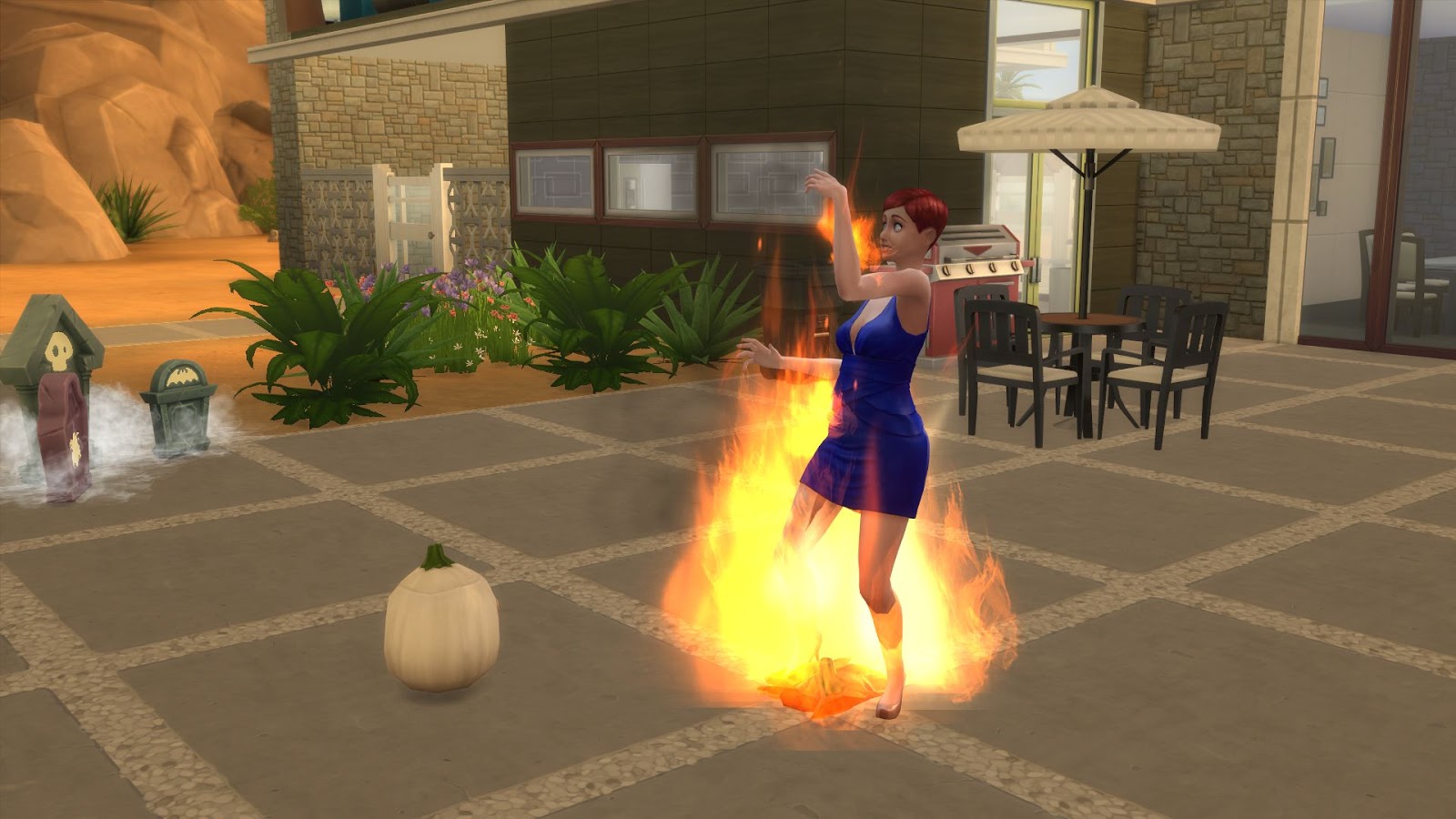
This image will make sense in a minute, I promise.
 
So what happens when your character runs out of terminal resources? What happens when they run out of the resources that prevent bad things from happening to them? The answer is obvious. Bad things happen.

So as their name implies, death & dismemberment tables are lists of bad things that might happen. They're also the au currant way of dealing with terminal resources. Despite their name though, they're not really about killing your character; they're about allowing your character to live.

No More Hit Points

The original death & dismemberment tables were a way to let your character survive falling to 0 hit points. The earliest, easiest mechanic for reaching 0 hp is to just die immediately. So the point of death & dismemberment is, maybe you don't die, even though your life is forfeit. Maybe bad things happen, maybe it gets worse, but you stay alive. And that's the point of these tables, to maybe stay alive.

In that regard, they're actually pretty forgiving. Consider 5e's "death saves" or DCC's "rolling over the body" mechanic for seeing if a character who falls to 0 hit points lives or dies. Unless you have access to clerical healing or some other kind of aid, 5e gives you a 50% chance to survive. It's a coin toss in slow motion. DCC uses a "Luck check" where you try to roll under your current Luck score. Considering that your starting Luck is determined by a 3d6 roll that averages 10-11, that you can earn more Luck by doing cool things, but that you also routinely spend Luck to improve other rolls ... I'm inclined to say that your chances of survival in DCC are probably usually less than half.

In contrast, look at the original d&d table. Look at Trollsmyth's really famous one. Hell, look at the one I wrote. There are lots and lots of these - they're a very popular houserule for handling what happens at 0 hp, they've even been baked directly into the rules of several retroclones. What they all have in common is that they put your chances of survival much higher than the base 50% of a death save. Every one of those tables gives you a 80-95% survival rate as a starting point. Of cooourse ... at the same time that you're trying to roll high, you're also supposed to subtract the damage from the killing blow from your roll, which worsens the odds somewhat. It's hard to say what "typical" lethal damage is going to be, but my guess is that most of the time, these hardcore, hardass, tear-your-arm-off-and-beat-you-with-it death & dismemberment tables are actually going to be slightly more forgiving than 5e or DCC.

No More Time

In a certain kind of game, running out of player time isn't really a problem per say. If the same, or mostly the same, group of players is meeting on a routine schedule, then when you run out of time, you can just ... stop playing. Wherever your characters are, whatever they're doing, you can just hit the pause button and pick up exactly where you left off next session.

But there's another kind of campaign. Call it "open table," call it West Marches style, if you like. In this style of campaign, there's no set group of players, they vary from game to game. There might not even be a set schedule, although that part's not, in my opinion, definitive of the style. If the players change from game to game, then each game session has to be self-contained, episodic. And that means that running out of time at the end of the episode IS a problem in an open-table game. Leaving off mid-adventure isn't really an option, or at least, not a good one, because you WON'T be able to pick up where you left off. So in a game like this, player time becomes a terminal resource, not just because the session ends when you run out of time, but because when you run out of time, you run out of your right to keep your character alive. You either end the session at a good stopping point, or bad things happen. Your life is forfeit.

It was Jeff of Jeff's Gameblog who had the really brilliant idea to apply the death & dismemberment table as a model to solve the running out of time in the dungeon problem. He came up with a relatively simple table called The Triple Secret Dungeon Fate Chart of Very Probable Doom. The idea here is that you actually start by making a kind of death save, with a flat 50% chance to make it out alive and unscathed. If your character level is higher than the dungeon level, you get a bonus; if you went in too deep, you take a penalty. If you fail that death save, your life is forfeit, and you roll on the Fate Chart, to find out which of 20 possible bad things happen to you. Mostly you just die, but there are a few options where your treasure and equipment can be recovered, and a few options where you're captured and could be rescued.

Like I said out running out of light above, running out of player time is a situation where narrative description fails as a resolution mechanic. In this case, it fails because you run out of time to say the words, rather than because you run out knowledge about how to speak correctly about the situation, but the solution is the same one I proposed above. If you can't narrate, then don't. Use a different resolution mechanic - rolling dice on a special table - and then later, start narrating again at a point where you're able to do so.

The uncharitable interpretation of this is that your characters are like Sims. Without the benevolent hand of a loving player to guide them, their default behavior is to walk around in circles, drenched in their own urine, until they starve to death - unless they have the misfortune to encounter a swimming pool or water fountain, which, they're SO stupid, they'll probably manage to set on fire, like in that picture I promised would make sense soon. I believe that Sim stepped on a pumpkin, which then caught on fire, and set her on fire. Left on NPC autopilot, your characters are idiots, and will probably die.

The charitable interpretation is that when you run out of player time, your characters run out of the will to adventure and just go into survival mode. All they want to do is get out of the dungeon, as quickly as possible, whatever may happen to them along the way. But the dungeon is dangerous, and so bad things happen.

D&D doesn't have any formal rules for PC morale. Monsters can roll morale and lose their will to fight, NPCs can roll morale and tear off in a blind panic, but aside from a few magical / supernatural fear effects, the players generally get to decide when to fight and when to run away. I've seen hit points described as being analogous to player morale - your character's hit point total is a measure of how willing you, the player, are going to be to continue putting them in harm's way. In the same way, player time might represent character morale. Your character only has the will to adventure when you're there to guide them. The rest of the time on the surface, they're content to live whatever hardscrabble lifestyle your downtime rules have in store for them. When you're not there in the dungeon, all they want to do is get back to the surface.

The alternatives to a table like this - in a West Marches style game, anyway - are either to just assume all the characters make it back to the surface safely, or assume that their lives are forfeit, and they all die in the dungeon automatically. The purpose of the table is to avoid making either of those assumptions, just as the purpose of the classic death & dismemberment tables is to avoid making the assumption of automatic death at 0 hp. Which brings us, finally, to the topic I started with, what to do about darkness.

No More Light

To be clear, when I say "no more light," I'm talking about total darkness, the kind you really do get inside caves, and that really is possible inside large buildings that don't have electricity. If you can still kind of see, then there's not really a problem. If you're in total darkness though, if you can't see at all, then I contend that is a problem for a game that consists, in large part, of the GM telling the players what they see. If the naive or default alternative is to switch over to telling the players what they feel, I also contend that won't really work.

GM: You feel rough cobblestones under your feet.
PC: I extend my hands and inch forward. What do I feel?
GM: Nothing.
PC: I inch forward again.
GM: Nothing.
PC: I inch forward again.
GM: Still nothing.
...
12 INCHES LATER
...
PC: I inch forward again.
GM: Nothi- no, wait! How long are your arms?
PC: I dunno, I'm like 6 feet tall, so maybe 2 ½ feet long?
GM: No, still nothing.


In a video game, this isn't a problem, because in a video game, you can move your character even if you don't know where they are, and the computer running the game knows when you bump into something. But in a tabletop game, I think it is a problem. It's not just that the GM has few good ways to communicate what the PCs experience to the players, it's also that there are few or no good ways for the players to communicate their characters' locations to the GM. Usually it doesn't matter exactly where you are within the fictional space of the game. If you're in a room for example, you can see the whole room no matter where you are within it. Further, if the GM asks you where you are, you can tell them your location by referencing other objects in the room that you can see. Perhaps you can tell where this is going ...

If you switch the game over to operating by feel, then suddenly it does really matter where you are, because you can only feel what you can touch, and you can only touch what's immediately next to you. Since you don't know what's next to you unless the GM tells you, and the GM only knows where you are by you telling them what you're next to ... the whole system breaks down. As I said, we don't really have the language for it. It's not just the judges who need a special language to talk about darkness, it's the players too. And even if the referee feels competent to extemporaneously describe the feel and texture of every space in the dungeon, the players still have no good way to communicate their movements within the fictional space.

So I don't really know what people do with darkness. You can ignore the possibility by making all dungeons at least dimly lit. You can ensure that the characters always have at least one magical or mundane light source, or that every party has a character with some kind of darkvision. You can try playing "Oops I Tripped Over The Ottoman And Landed Face First In The Dog's Water Dish Because I Can't See Where I'm Going: The Game", but I bet you'd only be willing to play it once. (OIOTOALF2ITDWDBICSWIG:TG is not affiliated with WOTC or any of its subsidiaries.) 

The options at your disposal are some kind of restriction on the information available to the players, or some kind of restriction or penalty to the abilities of the characters, or a death & dismemberment style table, or some combination of the above. I think I personally favor the table option, because as I think I've made it pretty clear, this is a situation I want a way out of as quickly as possible.

In our personal communication, All Dead Generations offered up his solution to exploring in total darkness: "My own current take is that when PCs are without light resources (and I limit continual light) they can continue exploring mapless. Movement takes twice as long (e.g. two turns to move through a keyed location) and if the exploration die comes up with torch exhaustion they become lost. Once lost the party members individually roll a D10 on a 2 - 20 table with a +1 for every room distant from the entrance. Things get worse the higher up the table you go. At 10 + there's death involved."

This approach actually combines all three methods. The players aren't allowed to map, so there's some restriction on the information available to them. The characters' movement rate is cut in half, so there's a penalty to their abilities. And then, once some other conditions are met, there's a d&d-style table. At a minimum, this table offers a 10% chance of death, but depending on how far you are from the entrance, it could be much higher, even automatic if you're more than 10 rooms deep.

Rise Up Comus proposes a d&d-style table gives a a 50% chance of death or forced retirement, a 25% chance of escape to the surface, and a 25% chance of capture, allowing for the possibility that a future character can recover the captured one.

And like I said, I agree that this is the right approach. If you want light and darkness to be important, make them important. Make running out of light as deadly as running out of hit points. Treat torches as a terminal resource, and after letting the players sweat while watching their last few matches burn out and go black, tell them their lives are forfeit, end the scene, roll on a table to find out which bad things happen to them, and resume the game with the survivors already back on the surface.