Showing posts with label sorcerers skull. Show all posts

Friday, February 6, 2026

Guest Post - More Thoughts on Space: 1999

 I wrote a guest post on the Flashback Universe Blog!
 
 
I recently started watching the show Space: 1999, and my friend Trey, who operates both Flashback Universe and From the Sorcerer's Skull, invited me to write up my thoughts so far.
  

Monday, September 4, 2023

The Forest Takes Everything

Over at From the Sorcerer's Skull, Trey has an idea for a spooky season campaign setting that really intrigues me.
 
Trey wrote: "the world that the players' would know and explore is a sort of mythic forest, a dark fairytale sort of woodland with no apparent beginning or end." Rather than being heroes or conquerors, the "adventurers are wanderers in the wood, dealing with the things the forest brings them."

But the detail that stood out to me most was this - the forest-dwellers cannot remember the past. They don't know the history of the forest, they don't even necessarily remember the history of themselves. "Memory, like everything else, gets swallowed by the forest."
 
 
from Over the Garden Wall

 
Imagine you have a certain number of lines of backstory on your character sheet. Simple, declarative sentences.
 
Maybe they have a mechanical benefit, like you can invoke them for advantage or inspiration. They could represent skills or contacts, life history events that grant you abilities. Or maybe they just define who you are, who you were, before the forest.
 
And then, as you play, they start to vanish. Maybe at the start of each session one goes away? You wake up, as though from a dream, no clear memory of how you got here. Just a sense that you chose this, even if it was a mistake. Perhaps a sense that you'd like to leave, that you have unfinished business somewhere else, even though the forest is everywhere. Definitely whenever you're at some sort of low point, the forest steals from you while you're down. 
 
You could cross them out - your backstory, your memories. Or literally paste new strips of paper over them to cover them up.
 
You can add new memories as you play. Meet new people, learn new things, accomplish noteworthy deeds on your adventures. But those aren't safe either. Eventually, the forest takes everything. Everything. Unless you can find a way out...

Wednesday, December 28, 2022

Roadside Picnic Basket Book Club - 2 - Blindsight

For the second meeting of the Roadside Picnic Basket Book Club, Trey from From the Sorcerer's Skull played host, and invited me to discuss the dungeoneering aspects of Peter Watts' novel Blindsight. 
 
 
So despite the cold, pull up a blanket, pour a cup of hot tea from your thermos, and enjoy the club. You can read the first half of our conversation here, and the second half here.

Monday, January 31, 2022

Roadside Picnic Basket Book Club - 1 - Roadside Picnic

Welcome to the first in what I hope will be a series of conversations between me and Trey Causey from From the Sorcerer's Skull about dungeon crawling science fiction. Our first conversation, and the club namer, is about one of the most famous works of Russian science fiction - Roadside Picnic. So pull up a picnic basket, and enjoy our chat!


Anne - I wanted to chat with you, because I know you're putting together a sort of Appendix N for some adventures in space, and I saw you mention Roadside Picnic as a source to draw from.

I really enjoy Roadside Picnic but it also occurs to me that it's kind of "having a moment" right now. I feel like I see a lot of people mentioning it as a potential inspiration.

Trey - It comes up a lot. It's one of Humza's favorites, for instance. 

Anne - It's very versatile in that sense, because if I recall correctly, Humza's setting is a pre-colonial fantasy North Africa, while you're talking about off-world adventures in a spacefaring future. But I can see the appeal in both cases.

Trey - Besides being a good book, I think it appeals to folks interested in games of treasure-seekers exploring weird and dangerous places is because that's exactly what it does!

I think it's probably a better inspiration for the "classic play" style of D&D than say Raiders of the Lost Ark because the protagonists aren't particularly heroic types and the dangers are weirder and more fantastical. It has scenes that are perhaps the modern equivalent of poking around with 10 foot poles. 

Anne - In a way it almost surprises me that it's not the textual basis for classic D&D adventures. 

But it occurs to me that maybe we should each take a turn summarizing the book, in case anyone reading this is wondering what we're talking about. I assume there are a few people who didn't rush off to Wikipedia the moment they saw a book title they hadn't read.

Trey - Sure, let me respond to that point about inspiring D&D first, if you don't mind. I think D&D is how D&D is by accident. It's like Star Trek Monopoly, in a sense. They used only the trappings and widgets of things they liked but repurposed them to something their wargamer minds knew how to handle. I think classical play is an ahistorical attempt to make these accidents of history make sense. 

Anne - I think what we now call "classic play" is as much a creation of the OSR scene in the early 2010s as it is a revival of any way that people actually used to play in the 1970s. From what I can tell, there were a lot of different playstyles back then, because people who didn't learn the game directly from Gygax or Arenson had to figure it out for themselves, and what they came up with was usually different from one another. So the OSR style of inching through a trap filled deathmaze is more like the canonization of one version of the past than a recognition of a single best or most common experience.

Trey - I think that's correct. It has antecedents, but it was one choice of many.

Anne - I feel like some OSR people disclaim any personal creativity and try to say that Gary invented it all, but to me it seems obvious that they invented new things and made choices about what to carry forward from the past. 

Trey - That's true.

Anne - I want to come back to your Star Trek Monopoly metaphor in a second, but we probably should describe the book first.

Trey - So Roadside Picnic is a Soviet-era Russian science fiction novel by the Strugatsky brothers that deals with the aftermath of a strange, presumably extraterrestrial "Visitation" at 6 locations across the globe. These locations are left altered in weird ways. There are anomalous artifacts and weird substances. As the governments try to keep a lid on these "zones" and exploit what they can technologically, a culture of stalkers arises that sneak into zones and take things to sell on the black market.

Anne - I like how much of the Strugatsky's invented language you managed to work your summary! I see it as a story about poor criminals with no other options for a decent living going into a bizarre environment, filled with deadly traps, to seek magic treasures, in a world where everyone is shockingly blasé to the wonders and the horrors of the Zone / dungeon. Even the treasures they find, which should inspire awe, get called "swag," and some types are common enough that they aren't even particularly valuable. 

The D&D attitude is there, alongside a plot structure that mirrors the classic dungeon delve.

Trey - I think the "poor criminals" part is interesting. Red is initially working for the government. Does the government exploration end? Or is it just Red finds the idea of making more money off the risk's he's taking more enticing?

Anne - There's even a guy who's infamous for bringing in hirelings to get killed on his behalf.

Trey - Yep. He's got a nickname, as I recall - The Buzzard!

Anne - Yes! It's been a couple years since I read it, but I think he's also the guy who loses all the bones in his legs to an encounter with Witch's Jelly.

Trey - Yeah. But I think it isn't so much they have no other options, but that these blue collar guys see this as a quicker way to wealth. It's dangerous, but there's a hint some of them are sort of thrillseekers, too, as I recall. What they do is seductive.

Anne - There are really two kinds of Stalkers, right? There are the blue collar workers who are doing it for the government, and the black market criminals who just want to sell swag to the highest bidder. Plus the occasional scientific tourist who wants to actually learn more about the weirdness of the Zone.

Trey - And of course, we learn the governments are benefiting from the black market trade, too.

Anne - Thrillseeking is a good way of describing it. These guys are looking for adventure as well as money. They're adventurers.

Trey - Back to D&D again!

Anne - Okay, so a minute ago, you compared D&D to Star Trek Monopoly. Could you say more about what you mean by that?

Trey - Sure. It's my shorthand for the trappings of one thing, but the substance of another. Star Trek Monopoly pays lip service to Star Trek, but is really just monopoly. A game that purports to be about Conan, or Fafhrd and Gray Mouser, or Gandalf, but is instead about dying in holes in the ground, has a similar sort of disconnect. I hasten to add, this does not mean it’s bad.

Anne - That's worth pointing out! But right, Conan doesn't work in a team, Gandalf never got eaten by a Gelatinous Cube while trying to steal Smaug's gold, etc.

Trey - Neither carry 10 foot poles!

Anne - I think that's also what I mean when I say I'm surprised Roadside Picnic wasn't a conscious influence. Because D&D is kind of like the plot Roadside Picnic, but with the cast of The Hobbit swapped in to replace the Russian lumpen-proletariat. 

Trey - I think that's right. It also makes me think how it might be interesting to think about a version of The Hobbit where the desolation of Smaug was a Zone!

Anne - True, we could all certainly lean in harder to the weirdness of the dungeon!

Trey - I do think there are ways in which D&D isn't like Roadside Picnic, of course, besides the modern setting. One, dungeon environments are mostly new spaces to adventurers with unknown dangers. The zones (mostly) seem known to the stalkers we follow, it's just a matter of if they can avoid the dangers. Two, they never haul about large amounts of valuables. No hordes of coins for them. Three, there aren't really monsters in the zones: just "traps" and "hazards."  I think you could do a "rationalized D&D" that was more like a medieval-ish RP, but as it stands D&D is a little bit Roadside Picnic and a little bit The Hobbit. Awkwardly.

Thursday, September 23, 2021

Why the Sun is Dark and the Realms are Forgotten

From the Sorcerer's Skull's recent posts about Dark Sun have gotten me musing about the relationship between the world of Dark Sun and other fantasy worlds within the WOTC orrery.

Magic in Dark Sun is scarce, and comes at a high price, especially compared to places like the Forgotten Realms, where magic is plentiful and virtually free. 

Suppose that the relationship between these planes isn't just one of coincidence or natural variation, though. What if it's not just that Athas has less magic and Faerun has more? Suppose that the relationship is one of cause-and-effect. What if the Realms are rich because Dark Sun is poor? What if Dark Sun is poor because the Realms are rich?

The basic idea here is that mana is a finite resource. Every time you use it to cast a spell, you're also using it up. (Or perhaps it replenishes itself, but slowly. Over geological time, not human time scales.) 

Faerun is a lush, tropical land supersaturated with mana. With mana so abundant, people use magic with abandon. Magicians are everywhere, and every other adventurer carries a magic sword, sings magic songs, punches with a magic-infused fist. People summon fire elementals to cook their breakfast, cast illusions to amuse their kids, rely on healing spells in lieu of any other form of medicine, brew potions so they can drink magic, make trinkets so they can wear it.

Athas is a desert. It's desiccated. There's very little mana left. Accessing it is is hard, few people have the ability to access it, and they only spend it on spells that are important. Even the most callous and depraved Sorcerer King or Templar Defiler isn't going to harvest the souls of a thousand worshipers or kill all the crops in a hundred mile radius just to iron their shirts, or light their cigarettes, or play a little light jazz to set the mood for a date. Even if they're going to waste their magic, they're going to waste it ostentatiously and dramatically as a show of strength, to impress an ally or overawe a foe. To waste magic in private really would be too much of a waste.
 
Dark Sun Creature Catalog cover by Wayne Reynolds
 
 
There are a couple possible relationships.

Perhaps Faerun is the past and Athas is the future. 

In ye olde days of yore, the Realms could use magic for anything, so they used it for everything, including the pettiest, stupidest shit you could possibly imagine. Goodberries on your cereal in the morning. Disposable Tenser's floating discs to carry home your groceries. Bardic inspiration before you take a test. Scrying when you don't feel like walking to the library. Leomund's tiny hut to keep out of the rain. Mordenkainen's magnificent mansion for a weekend getaway. Glamours on everything. Continual lights on everything. Sleep spells to knock you out when all auras and dweomer's you've been staring at all day start to mess with your circadian rhythm.

Eventually the supply of mana just can't keep up with all the demand. Peak Mana arrives when wizards have to start going farther and farther afield, work harder and harder, longer and longer, to bring back a diminishing supply of mana. Sadly there's no such thing as renewable energy in this world. Some genius invents solar power and starts extracting elemental fire straight from the heart of the sun. Some other geniuses come up with wind, geothermal, and hydroelectric energy, letting them convert the air to smoke, the seas to salt, the ground to dust. The inexhaustible bounty of the Realms is exhausted, and there simply isn't enough mana from any source to maintain civilization in the style to which it had become accustomed. 

Then comes the Collapse. Then there is no Faerun anymore. Then there is only Athas.

Or perhaps Faerun and Athas are separate. Perhaps Faerun is a resource extractor, and perhaps Athas is a resource.

If Dark Sun and the Forgotten Realms are different planes, then when Faerun starts to run low on domestic mana, they'll begin plundering their neighbors for supply. Perhaps they start by whaling - capturing dragons, demons, angels, and gods to press them like olives, crush them like grapes, until hot, wet, living mana pours out to fill the pipes and keep the faucets running. 

But as the herds then and the fisheries grow sparse, Faerun's prospectors will turn to other worlds. Some planes are easy to reach, and have deep wells of easily tapped mana. Some planes are like shale oil and tar sands. They're hard to get to, their climate is hostile, and it takes so much more work and effort to extract their mana, like wringing it from a damp dishrag. Athas is the tar sands. Athas is wrung out.

Magicians in Dark Sun divide themselves into Preservers and Defilers. The locals do their best to monitor their Mana Footprint, to cut back on their Mana Emissions. They name and shame. They reduce, reuse, and recycle. But it doesn't matter, because theirs is a problem that can't be solved by individual conservation or local action. Every mage in Faerun is a Defiler ... of Athas.

This is why the Realms aren't forgotten exactly, but they are a closely guarded secret. When the Mana Barons and their pirate crews set sail, they fly no flags, they carry no papers. They dare not bring with them anything that could identify the name or location of their homeworld. 
 
Dark Sun Campaign Setting cover by Wayne Reynolds
 
 
The really exciting part of either idea comes when the people of Faerun and Athas finally get to meet.

When people from Faerun come to Dark Sun, they arrive as imperialists. They've landed with their cargo holds empty, and won't be leaving until they fill them up with mana. They're not particularly concerned about how big a mess they make, or how many people they hurt, while doing it. Indeed, there are surely some among their number who are mostly there for the chance to commit violence and atrocities in a context where their home government will not only tolerate their depredations, but reward them for it. 

Others may be motivated by patriotism. Still others find meaning in their work knowing that they're helping to maintain the high standard of civilization, imagining that the Faerun too would be a desert ruin without their efforts. And some are just there for a paycheck, doing the only job they could find at the time they needed work, their only consolation the knowledge (or at least hope) that the money they're sending home is enough to support the people they're sending it to.

When citizens of Athas arrive in the Forgotten Realms, they want revenge. If they're there, it's because they've finally realized who destroyed their world, and they're going to make those fuckers pay, and stop them from plundering anyone else.

The only real question, when the hotwired Spelljammer crashes through Elminster's tower like the Old Mage built it out of Jenga blocks and plows through the center of Waterdeep like a plow through that verdant, mana-rich soil, when a mob of gladiators and psychics and giant mantises tumble out of the wreck wearing leather bondage outfits and carrying weapons made of the bones of the last people they killed, the only real question is whether they have a plan to bring the fight directly to the Big Mana companies who've been financing all the drill sites on Athas, or if they're just going to start breaking things and killing people in an indiscriminate frenzy of vengeance.

Either direction of visitation sounds like a pretty good game session to me.

Tuesday, January 19, 2021

Tolkienian Science Fantasy - Replacing the PC Species

Recently, Trey of From the Sorcerer's Skull proposed a worldbuilding concept that interested me. How would it change the game to replace the species available to the player characters?

Trey first proposed imaging a fantasy setting without elves, dwarves, or hobbits, but featuring the species from TSR's Star Frontiers setting - the insect-like Vrusk, amoeba-like Dralasite, and flying-monkey-like Yazirians.

Later, he suggested a pulp scifi campaign using the same species, set entirely within the Solar System. (Trey has a bit of a cottage industry reimagining interstellar scifi as 1930s-style pulp confined to just our one star system. In addition to the Solar Frontiers I just mentioned, he's briefly written about Solar Wars, and he has a whole series of posts about Solar Trek.)
  
  
Elf Replacements - Vulcan, Talosian, Minbari
 
I want to build on his original suggestion though, and try some worldbuilding that stays relatively close to D&D's world, populated with Tolkien's heroes and monsters, just with, you know, different heroes, and different monsters.

We know that constraint encourages creativity, and I think that's especially true of worldbuilding. By limiting yourself to a small number of component parts, you can create a compact, thematic setting that's uniquely your own. Look at the 10 Monster Setting, or the 7 Class Setting, or the New New Crobuzon Challenge - they're all worldbuilding prompts that encourage you to select a small number of components and use them as the basis for a fantasy world.
 
If your handful of seedlings are particularly weird, so will be the garden that grows from them. The downside of that is that you can end up with a setting that's so weird that it doesn't really make sense to other people, and maybe not even to yourself. And obviously, actually running a campaign like this requires securing enough player buy-in beforehand, since their options for possible characters are radically restricted compared to a more open setting.

(Alternately, if you wanted, you could spend your Session Zero letting each player pick out their bespoke species and occupation combo, and then working together to imagine what sort of world it must be if those particular sorts of characters are a totally typical, run-of-the-mill adventuring team.)
  
  
Dwarf Replacements - Klingon, Narn, Rigelian
  
A variation on this kind of prompt would be to try to make your own "French Vanilla" setting. By that, I mean a setting that mostly draws on the tropes of vanilla fantasy, but is specific enough to be uniquely your own, the kind of thing Trey writes about here. And as both Trey and Jack from Tales of the Grotesque & Dungeonesque have argued, vanilla fantasy is, almost by definition, something that is understood by almost all potential players, something that essentially generates its own buy-in because its expectations are so clear. Done well, french vanilla might give you the best of both worlds - enough familiarity to form a solid basis for a shared fantasy gameworld, but enough difference to make something that's personal and interesting.

(I had some success with this in a campaign where I offered my players a handful of classes - human fighters, thieves, and wizards, plus "venturers" who are basically adventuring capitalists, or like, white collar thieves; elven druids and "courtiers", another variety of legit thieves; and dwarven roboticists and tomb robbers, who are, you know, basically more thieves. My players seemed content with the assortment, and I felt like I had established a strong sense of what sort of people go adventuring in that setting.)

What I've called the "Non-Core" is one source for a french vanilla setting. The non-core is made up the kinds of ideas that don't usually make it into the core rules of most fantasy games, but do usually appear in the first batch of expanded content. 
 
Imagine the sort of setting you end up with if you replace elves, dwarves, and hobbits with drow, duergar, and svirfneblin? Instantly you have a darker and spookier campaign setting, and one will make extensive use of the Underdark as a location. 
 
Or what if you used only the species that got added when OD&D expanded to become AD&D? What if you had only half-elves, half-orcs, and gnomes? Unlike the "good fey" of a straight Tolkienian game, this settings imply that humans deal with the Unseelie Court as often as the Seelie, and that full-blooded elves are, in their own way, as monstrous as orcs, and both are ineligible as player characters.

Restrict yourself to just "new school" creature types like tieflings, dragonborn, and goblins, and while Old School players might grumble about the loss of elves, the younger generation of Critical Role and Adventure Zone fans might not even notice the restriction - or if they did, they might be more upset by the loss of aasimar and genasi than of hobbits and dwarves.

In a variation on Trey's initial idea to use the species from Star Frontiers, you could also borrow the playable species from TSR's Alternity game - the psychic Fraal, cybernetic Mechalus, bat-like Sesheyan, fringed lizard Tsa, and bestial Weren. 

(One advantage of using totally alien species like these is that it lets you get away from an effect you sometimes see with the standard demi-humans, where each represents a different extreme, with humans like Goldilocks in the middle, defined by our flexibility and moderation. I suspect but I don't know, that Tolkien intended his elves to seem French and his dwarves German, one overly artistic and cultural and the other too industrial and militaristic compared to the "just right" modern middle-class British hobbits and medieval British humans. Though for all I know, old JRR could have been taking potshots at the Irish and Scottish, or maybe I'm imagining chauvinism where none exists. In other people's writing, I think I sometimes see elves, dwarves, and hobbits as representing feminine, masculine, and childlike qualities. This is fine if you want it, though it always contains some embedded assumptions about what humans are "supposed" to be like, which others might find objectionable. Scifi species potentially give you the chance to make humans just one species among several, rather than the center of Creation.)
  
  
Hobbit Replacements - Ferengi, Orion, Centauri
 
But suppose for now that we want to stick fairly closely to the Tolkienian archetypes, but use alien species to create a kind of science fantasy french vanilla. Still unquestionably D&D, still built on familiar tropes, but with enough a difference to make this campaign feel special. For each species being replaced, I have a suggestion from regular Star Trek, from Babylon 5, and from the original Star Trek pilot episode "The Cage".
 

Elf Replacements - The alternate elves I've chosen here all reflect a vision of elves as "human, but better". I could write a whole post - and who knows, maybe sometime I will - about how fundamentally weird it seems to me that there's a widespread belief reflected in science fiction, everything from pre-Golden Age pulp stories to Star Wars and The Matrix suggesting that human perfection, whether it comes on a species level through evolution or individually through enlightenment, looks like an emotionless ascetic in a monochrome outfit, living in a harsh environment, spending all their time meditating for mental discipline and learning to fight real good.

Vulcans - The Vulcan homeworld is a harsh desert with habitation concentrated around the few oases. Both as individuals and a society, they used to be very passionate and emotionally-driven. At some point in their past, they adopted en masse a philosophy of logic, asceticism, and emotional self-control. The lawful Vulcans have a counterpart in the chaotic Romulans - who are the same biological species, but a different society, one that split off from the other Vulcans before the adopted their new philosophy (or perhaps as a rejection of it?) Vulcans famously have the the abilities to perform a Nerve Pinch that can stun most humanoids, and a Mind Meld that allows them to share thoughts and memories.

Minbari - Minbari society is divided into three castes - warriors, workers, and religious. They value honor and tradition, formal rituals and baroque decorations. Their society is the oldest of the current age, and they have the closest relationship with the Vorlons, the last remaining elder civilization of the previous age. They grow buildings out of crystal, and their ships incorporate biotechnology. Their warriors are skilled martial artists, while their religious caste can use crystal-based technology to produce almost magical effects.

Talosians - The remaining Talosians are the last survivors of a once great civilization. Their physical bodies are weak and somewhat frail, but their enlarged brains possess incredible psychic powers. They speak only telepathically, and routinely project illusions to disguise themselves and their allies. Talosians can read thoughts and project physical pain, but their powers can't penetrate really powerful emotions, such as rage.

I would represent Vulcans and Minbari with D&D's Monk class, which is a good match for their fighting style. I would probably pick the Cleric as a second option. Spells like Command, ESP, and Hold Person are pretty good representations of their abilities. Talosians should probably be Bards and Wizards, perhaps with an emphasis on illusions and enchantments to match their powers.
 
 
Dwarf Replacements - Although we might think of dwarves as being miners, or engineers, the replacements I've chosen all kind of tap into the "proud warrior race" archetype. Really, scifi has an embarrassment of riches for this particular trope, so you have plenty to choose from that aren't listed here. Your only limitation is probably your willingness to use a species that's been portrayed as an antagonist for your player characters, since these guys are rarely the heroes in fiction.

Klingons - The Klingons are a very proud society. They prioritize personal honor and the glory won in battle and they inflict harsh corporeal punishment for all crimes and moral transgressions, especially cowardice and other forms of perceived weakness. They consider a death during combat to be the only acceptable way to die. Klingons have distinctive ridged foreheads and fight with a two-handed, multi-pointed sword called the bat'leth.

Narn - The Narn have a reptilian appearance, hairless and mottled with spots. Although once a peaceful society, they were conquered by the Centauri and their planet occupied until they could drive the invaders out. They are now militaristic and intent on both protecting themselves and getting revenge on their enemies.

Rigelians - Okay, so technically these guys, the inhabitants of Rigel 7, are called Kalar, while it's the inhabitants of Rigel 5 who get the honor of being called Rigelians, but it's clearly the better name, and could be applied to anyone from that star system. They are notably taller than other humanoids, and prefer to fight with spear and shield. While Klingons and Narn routinely wear metal armor, Rigelian's wear thick layers of leather and fur.

All three of these species should probably receive a Fighter option, although they have different fighting styles - Klingons prefer two-handed weapons, Narn daggers, and Rigelians fight with one-handed weapons and shields, and are the only species here who wouldn't use guns. Although most Klingons vocally support honorable conflict, their ships use invisibility cloaks, they surgically alter spies to pass as human, and occasionally use poison and suicide bombs to achieve victory, even at the expense of honor. Their second option should probably be Assassin, or its equivalent. The Narn are shown to be pretty religious, so their second option should be Paladins or Clerics, even though in the show, it's a big deal that they're one of the only species to not have indigenous telepaths. Rigelians are clearly also Barbarians.
 
 
Hobbit replacements - The symbolic role of hobbits is a bit unclear to me. As I said above, I think Tolkien wrote them as being essentially like modern humans, contrasted against the old-fashioned humans of Rohan and Gondor. In most D&D settings, they don't seem to have a culture that's any different from human society, with the exception of Eberron, where they have their own little Dinotopia. For my replacements here, I've chosen species that are cast as sort of "dark mirrors" of humanity, reflecting our worst qualities back at us. Instead of modern middle-class homeowners, I've chosen capitalists, gangsters and slavers, and colonizers.

Ferengi - The Ferengi are mercantile capitalists. They don't particularly make anything, but they make money as middlemen, buying low and selling high. Their whole society is structured around commerce; their Rules of Acquisition are practically a sacred text, and their currency, gold-pressed latinum, is more-or-less the currency of universal interchange. Their leader is simply whichever Ferengi has the most money at any given time. The Ferengi have very prominent large ears, and they're immune to telepathy. Ferengi society classifies women as property, owned by their fathers and later by their husbands; by law and custom, their rights are severely restricted.

Centauri - The Centauri are a society past their prime. They once had an expansive empire, but most of their former colonies have since won independence. The hierarchy of their society is based on proximity to the hereditary emperor; status in the royal court is the primary determinant of social position. Centauri culture and fashion are still very much frozen as they were at the height of their power; anything new is almost automatically worse. Their taste is ornate and baroque. Centauri look very much like humans, although their women shave their heads bald, and their men grow fan-like crests of hair, the taller the better.

Orions - The Orion people have carved out a niche for themselves as dealers in illegal merchandise. While the Ferengi sometimes dabble in legal vice - such as gambling and holographic prostitution - Orions deal almost exclusively in contraband and outlawed services. Orion slavers kidnap members of their own species, and others, to sell into forced labor. Orion pirates raid ships and seize their goods. Orion gangsters make loans, collect debts, deal illegal drugs, and sell stolen goods they received from the pirates.

All three of these species should obviously receive Rogue as one of their class options. After that, I'm a little bit torn. Ferengi and Centauri would both probably alike another roguish archetype, but more along the lines of a Merchant or a Noble, though most rulesets don't treat those as playable classes. Bard might be a fair representation of their more flamboyant and charismatic members? As for the Orions, I think they could use a Fighter type to act as enforcers for some of their more violent crimes.

Thursday, October 1, 2020

Recent Campaign Settings - Underwater Exploration, Arconauts, Alternate Planets, Pangaea, Karmic Depth, Un-Forest

Recently I've noticed a few people announcing big, bold campaign ideas. They're in various stages of progress - some have been used in play, some have mechanics, some are still just ideas in progress. But they're new and exciting and they all possess a certain science-fictional sense of wonder.
 
 
Diver by Aleksandr Plikhta
 
A Distant Chime proposes an underwater campaign they're calling Point Nemo. Currently this exists as a set of rules and recommendations for playing underwater. The concept art, focus on resources, and commentary around the rules all suggests a campaign of deep sea dungeon crawling, perhaps something akin to the Maridia region in Super Metroid.


The Light Fantastic by Josh Kirby
 
Sheep & Sorcery proposes Arconauts!, a campaign of Space Wizards exploring the Void. Players take on the role of apprentice wizards on the asteroid of Merlin's Rock, preparing to depart on the first-ever multi-person space mission launched by the College of Wizardry and Void Exploration. The wizards get a shared starship, and magic that works like the suite of abilities we expect from a well-equipped scifi character. The tone here seems to be lighthearted fun, somewhere between gonzo and silly. The idea of conducting playful, cartoony wizard science reminds me of Scott Anderson's short story "The Study of Anglophysics".  

(If you need additional stopping points for this campaign, you might consider checking From the Sorcerer's Skull's random planet generator, and I Don't Remember That Move's recent list of unusual planets.)


Alien Landscape by Jason Coates
 
Worldbuilding & Woolgathering's whole blog is devoted to the world of Terrae Vertebrae, and most of that is focused on the region of Punth. But what really caught my eye was a post about the alternate planets that surround this world, and their correspondences to alternate metals, both inspired by Latin, but also allowed to become their own fictional things. The Qryth are clearly inspired by the Green Martians of Barsoom, so perhaps there'll be more interplanetary content in the future.
 
(The rules for this campaign are based on Roles, Rules, & Rolls' 52 Pages rules.) 


Sol by Luka Rejec
 
Stuff by Solaris 242 offers a third interplanetary setting. The Mappae Solis is an setting that spans the entire solar system. The posts in this series are all descriptions of planets and their primary fantastical inhabitants. The writing mixes scientific terminology and the style of technical writing with a bit of ironic detachment and literary prose. This time it was Pangaea, with its continental desert and kingdom of Archaea, that caught my eye.
 
(Both the alternate planets and Mappae Solis remind me a little of From the Sorcerer's Skull's delightful Baroque Space campaign setting.)


Chamber of Mirrors of Retribution
 
Weird & Wonderful Worlds has developed an entire game called Maximum Recursion Depth around their new campaign setting. The players are Recursers, people who able to consciously draw upon the supernatural powers of their own Poltergeist Forms, who search for lost Poltergeists wandering the Earth and return them to the appropriate Court of Hell. The player characters are also all deeply flawed people, and players have a goal of trying to fix their own characters' Karma as much as solving problems out in the world. One quick warning, the game takes place in a setting where reincarnation is both real an automatic, and where it's a viable strategy for a character to commit suicide in order to reincarnate.

(Incidentally, the image above is one that maxcan7 selected. It looks old enough to be in the public domain, but I don't know the artist. It depicts a layer of the Diyu, the realm of the dead in traditional Chinese belief. Diyu is ruled by 10 different kings, each with their own courts, and it's divided into 18 layers - or 18 Hells - and while that number stays consistent, there appear to be at least three different versions taken from different literary sources. Imagine if Dante's Inferno had two major competitors with their own variant Circles of Hell! Wikipedia's description also makes Diyu sound like a place that might interest gamers: "Diyu is typically depicted as a subterranean maze with various levels and chambers.") 


timelapse from Plant Earth II - episode 3 "Jungles"

Profane Ape has a conceptually dense setting idea. In a world filled with different types of magical fire, one type, Un-Wildfire, burns in reverse, creating hideous forests of Un-Trees grow backwards in time, assembling out of ash and smoke. The campaign is set on a plateau dominated by an Un-Forest, full of poisonous lichens, giant feral hairless cats, friendly giants who enjoy caber-tossing, and an evil wizard with an army of servitors that are like living statues made of lead. Phew! I'm especially curious to see how this one develops.


The Vaults of Vaarn blog header, art prooobably by Moebius?
 
Bonus, the entirety of the Vaults of Vaarn blog as it exists currently is devoted to a single campaign setting, which I would describe as "graphic novel mash-up of Jack Vance's Dying Earth stories and Gene Wolfe's Book of the New Sun as illustrated by Moebius". Excitingly, there appears to be a zine coming out in the very near future. Update: the zine is out!
 
 
There's some other interesting worldbuilding going on with bloggers trying their hands at megadungeon building and the Gygax 75 challenge, but I'll talk about those another time ...

Monday, May 11, 2020

Advice on Campaign Mysteries from From the Sorcerer's Skull

A little while back, Trey from From the Sorcerer's Skull wrote about how he builds mysteries into his campaign settings, in response to a question I asked him. Ever since, I've been meaning to collect and share some of Trey's other advice about building a mystery-filled campaign.


I first noticed that From the Sorcerer's Skull had advice on campaign mysteries when Trey posted a list of six unknowns in his Land of Azurth campaign, and then a follow-up to check-in on how many his players had solved.

In The Cultivating and Care of Campaign Mysteries, Trey lays out five pieces of concrete advice for creating a mystery-filled campaign:

- Embed the mysteries at the time of setting creation
- Don't decide on all the answers
- Create recurring NPCs to encourage player interest
- Create treasures that connect to the mysteries
- Build on player ideas

The first bit of advice here seems obvious, but probably is worth pointing out explicitly. You need to decide on some secrets early in your setting design process, so that you'll be able to decide on hints and clues to get your players interested. "If you want the players interested in the mysterious background of your setting, it has to be there."

His second piece of advice seems to contradict the first, but I think the idea is that you should decide on questions, but shouldn't decide on all the answers. Some questions your players might never investigate, and so might never need an answer. Other questions, an answer better than what you might have originally thought of could emerge as a logical conclusion during play.

I feel like this relates to the advice to build on player ideas. By that, Trey means trying to connect the player character backstories to the campaign mysteries - giving the characters a stake in the mystery, or using elements of their backstory as clues. But I think building on player ideas can also mean building ideas that they propose while they're investigating. When they describe what they've learned so far, and what conclusion they draw from it, that might sound more correct than what you originally thought of, and that's okay.

Trey's other two recommendations here are to use NPCs and treasures to help get the players involved in the mysteries. NPCs who act suspiciously might suggest themselves as suspects. The search for a famous treasure might reveal clues that illuminate the setting's history. And both NPCs and treasures are things that players want to interact with and learn more about, making them a source for clues that players will want to learn.


This piece ties in well with some of Trey's other advice about campaign setting creation. Adventure Time and Campaign Construction is a defense and explanation of making some of it up as you go along, rather than making it all up in advance. Setting History Should Do Something is a more general discussion of what kind of setting material is most (and least!) useful to make up, regardless of when you do it.

Trey explains his reasoning for not creating too much of your setting in advance:
- The campaign should start simple to make it accessible
- Seeing what the players like and respond to can help guide your setting creation
- The setting should only be revealed a little a time, in ways that connect to the adventure

A lot of the idea here is to slow down the pace at which you invent setting details to help enforce a slower pace of revelation. You don't want to overwhelm your players with too much detail before they even start playing, and if you haven't written the details yet, then you can't over-share them.

In addition to your players proposing ideas and theories at the table, what they're interested in (and what they're not) can help guide you to only create the things they want and you need. Again, you don't want to reveal too much detail during each gaming session; leaving things undecided prevents you from revealing more than you should.

And again, Trey suggests using monsters, NPCs, and treasures as like "hooks" to try to attract player interest and to show you what they care about. When they start tugging on a string, it's time for you to start fleshing out whatever's at the end of it.

The idea here isn't that you make it all up along the way, but rather, you start with a strong foundation and build it as you go, rather than starting with the entire edifice (or starting with nothing!)

When you are writing some backstory for your campaign, Trey recommends that backstory should:
- Reinforce the themes, flavor, or mood of the setting
- Establish constraints or parameters for adventures
- Provide obstacles for players overcome or toys for them to play with
- Avoid describing events that are repetitive or don't directly impact the present day setting

One way to think about this advice is to not write setting material that isn't actually important to your setting; another is to make sure to let your players interact with whatever is important.

Eberron is a bit guilty of violating Trey's suggestions here, with its ten-thousand year backstory, its series of highly similar apocalyptic invasions by varieties of reality-warping demons, and its setting-defining war that's finished before the campaign starts. Carcosa suffers from this too - there are psychic powers you'll never roll high enough to receive, cool alien artifacts you can't use, rituals you're (supposedly) not supposed to perform, and even a titular city that isn't really even there to visit.

Even the core rulebooks of most editions of D&D are guilty of this is in a way - playing the way the rules suggest, by starting at 1st level and likely dying multiple times while trying to level up, the books are filled with class features you'll never receive, spells you'll never be high enough level to cast, monsters you'll never have enough hp to fight, and artifacts you'll never find as treasure. That's not just because there's too much stuff to include it all, but because so much of the coolest stuff is explicitly walled off where most players will never get to it without breaking the rules. (Plus NPCs who sound suspiciously like Gary and his friends - they're more powerful than any PC, and either you'll never meet them, or they'll totally overshadow you if your paths ever cross.)

The way I interpret Trey's advice here is, basically, don't do that. Whether you're laying the foundation for your setting before the first game or adding details mid-campaign, figure out what's supposed to be important, and give the players the opportunity to encounter it right away. Whether that's as clues they keep running into, rumors they keep hearing - or as monsters, treasures, NPCs, or adventuring sites they actually get to see - give them the good stuff. (Because if you don't, a corollary of this idea is that whatever you DO give them is what your campaign is actually about - no matter what you intended.)

In a mystery campaign, presumably that means foregrounding the mysteries, the hints that lead you to wonder about them, and the clues that help you solve them. If you built mysteries into the backstory of your campaign, but the players never learn about, or find any evidence to help unravel them, then they're essentially dormant, and whatever your campaign's actually about, it isn't about solving those (unknown, unrealized) mysteries.


Azurth isn't a sandbox, it's got an episodic, mission-based campaign structure that gives Trey a bit more control over which part of the setting his players are interacting with each session. But he does have some ideas for building a setting where they player are more free to wander around looking for secrets. In The Weird Town: Investigative Sandbox, he offers some ideas for creating a compact setting where almost every major site holds a mystery.

- The town has many distinct secrets to investigate
- The town itself is weird and mysterious (not just a neutral site where crime coincidentally occurs)
- The player characters might be outsiders, but have a connection to town that gives the investigation some urgency


Finally, Trey also has some concrete advice for GMs to use to keep their players' investigations moving along. In The Simple Art of Mystery, he offers seven tips for GMs so they can facilitate (rather than hindering) their players' attempts to solve mysteries:

- Make sure the players want to solve a mystery
- Have a plan but leave some things open
- Always let the players find the most important clues
- Repeated interactions with the same NPCs always reveals new information
- If the players reach an impasse, an NPC will always react to their investigation so far
- Every NPC has a secret
- The players can solve mysteries without being Sherlock Holmes

The first piece of advice here is another bit that seems obvious but bears mentioning, which seems to be Trey's hallmark for starting off these pieces. Make sure your players know they're solving mysteries, and make sure they're on board to do that.

The next piece of advice here is another hallmark, you need a strong foundation in order to leave meaningful clues, but don't fill in every single detail in advance. Your players' guesses about what's going on might supply ideas worth including in the canon, and their actions during the game might cause you to invent details you couldn't have planned to include. When this works, it creates a sense that the players have discovered something true that even the gamemaster didn't realize before. But for that to work, these discoveries probably shouldn't contradict information you planned but never revealed.

Trey places a lot of importance on NPC interactions, which feels appropriate. Your players can search a room and find all the physical objects in it (and if any of those objects are clues, Trey recommends letting them find the object, rather than risking failure with a skill check) - but figuring out the meaning of those objects is probably going to require talking to NPCs. Just like every building in the mystery town houses its own weirdness, every NPC has their own secret. In addition to solving your main mystery, you can also make progress by figuring out what each person is hiding.

You probably learn as much from a clue-object directly as you're going to learn the first time you look closely at it (at least within the game!) - but you can always learn new information by talking to NPCs, even the same NPCs you talked to last time. If you have new questions, they have new answers. If you don't have new questions, because you've hit some kind of impasse, then it's time for an NPC to do something that generates new information. The mystery shouldn't exactly solve itself with no input from the players - remember, they're supposed to want to be here doing this - but it's a classic trope of the genre that having nosy kids start poking around spooks the villain into reacting. Canny investigators sometimes do things simply to provoke a reaction that will reveal a vital clue. Arguably, in fact, those villain reactions should happen with some regularity, even before the players have exhausted all their current leads. Just make sure that however the villain reacts, it actually does generate new questions to ask, new NPCs to talk to, or new places to look for clues.

Which is why Sherlock Holmes is probably a poor model for mystery solving in RPGs. In the popular imagination at least, Holmes is a guy who finds some ash from pipe tobacco on the ground, tastes the ashes, then calls on his voluminous memory of varieties of tobacco and where each type is sold across town and combines that with his vast experience with licking ashtrays to produce a list of tobacconist shops the villain must be a regular at. His shtick is that stuff that you'd normally need a crime lab for, he can do in his head.

But that's not how mystery solving goes at the RPG table. For obvious reasons, the players can't analyze the clues that way in their own heads. What they can do is ask the gamemaster "hey, would my character know which shop sold the tobacco that produced this ash?" But that's not nearly as interesting as getting the same answer by finding the genius perfumer who can discern the tasting notes by sniffing the ashes, then taking their findings to the blustering and self-important tobacco sommelier who knows all the shops in the city. In both cases, the players ask the gamemaster a question and get an answer, but it's so much more interesting if the answer comes out of the mouth of a fascinating NPC than if the GM simply states "sure, your character's a chain-smoker with pica, here's the address." In a game that's not about solving mysteries, maybe it makes sense to do a skill check, get the information, and move on, but if your purpose for being there at the game table is to enjoy the process of the investigation, then I think Trey's right, Holmes isn't a very good model for how that should go.

Saturday, April 18, 2020

Session Report - 5e Undermountain - Temple of the Azur Volcano

Life under quarantine continues, and I'm continuing to use D&D as a form of escapism to deal with the stress and isolation of staying home all day, every day, both for my own safety and to help protect the safety of "the herd" (which has got to be one of the least flattering metaphors for human society).

Some players I've run in-person games for asked me to run an online game, and one of them requested that we use D&D 5e, so I'm game-mastering my first ever Fifth Edition game. My plan was just to default to the Undermountain megadungeon from Waterdeep: Dungeon of the Mad Mage, but it turns out that the first dungeon level there is for 5th level characters, so I've been improvising a little to get the party up to 5th level so they can enter the Undermountain.

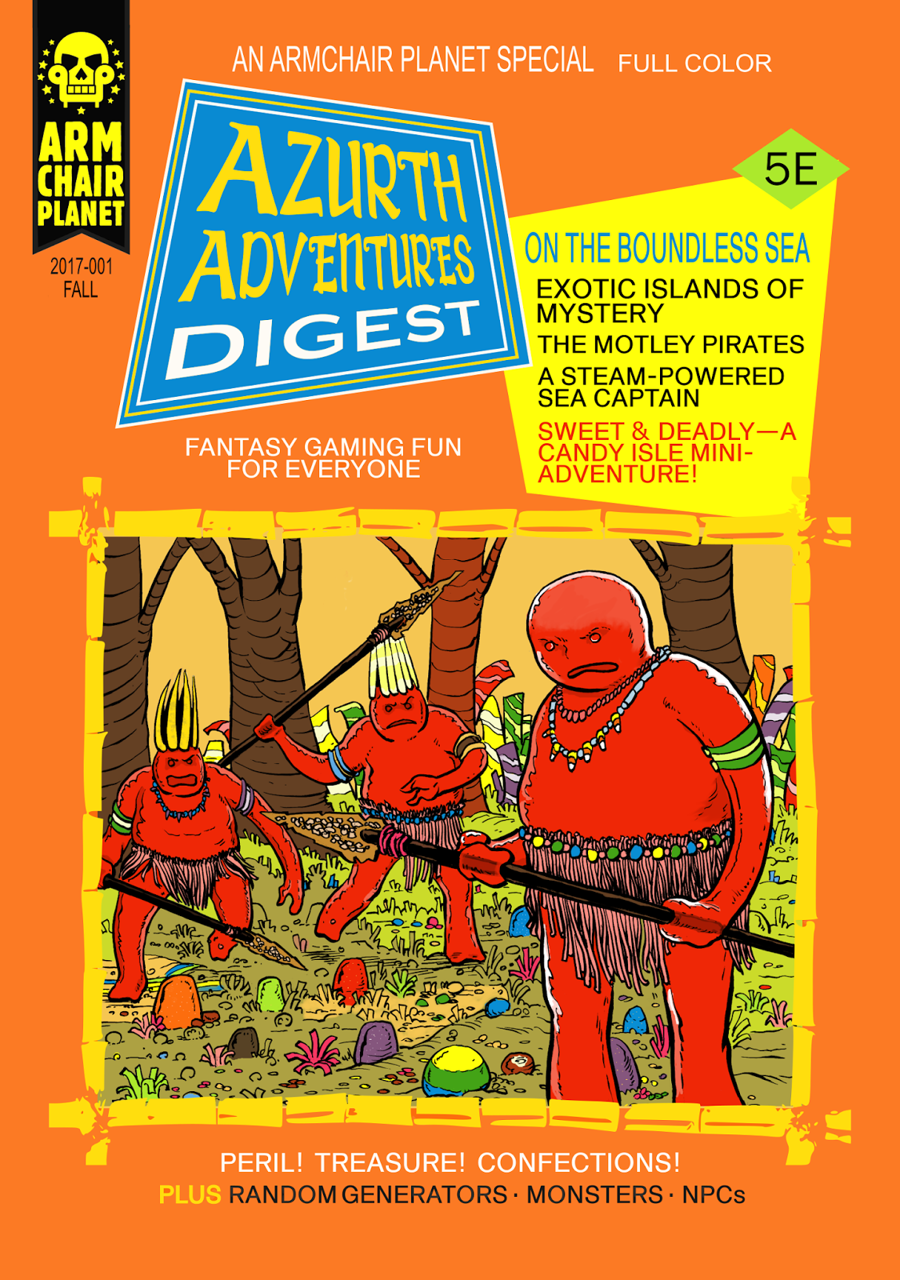
Their first adventure was in the Temple of the Azur Volcano, which I've adapted with very light re-skinning from "The Candy Island!" adventure from the Azurth Adventure Digest.


SESSION 1

Cast of characters:
Raku Chilhuly - dragonborn guild-artificer, 1st level artificer - played by Emily
Willowbald Hornblower - halfling noble, 1st level bard - played by Steve
Nehryx - centaur outlander, 1st level fighter - played by Corey

I started by asking the players to introduce their characters to me. I had helped Emily and Steve a bit with 5e's character generation process, but I let each player come up with their own backstory however they wanted.

Raku Chihuly is a glazier and glassblower who was raised by the Glassblower's Guild. She's spent her left so far making beautiful glass objects, but wants to find rarer materials and learn to make magic items.

Willowbald Hornblower is the black sheep of his family. The Hornblowers are synonymous with their successful pipeweed mercantile house. They grow it, bundle it, dry it, and sell it, making a fortune along the way. Willowbald tried to chart his own course in life, and attempted to become a vintner, but winery failed, and now he lives on a ramshackle estate at the edge of town. He hopes to learn some new techniques for running a vineyard, or find some new merchandise to sell to try to get back in his family's good graces.

Nehryx is from far away, from a plains that's dominated by centaurs and their ancient rivals, the minotaurs. Nehryx wanted to explore up in the mountains where the giants live. He was kidnapped and enslaved by a traveling circus, variously shackled, humiliated, and physically abused, until his will was nearly broken and he was ready to die. Eventually, the circus owners wanted Nehryx to stage gladiatorial combat with an enslaved minotaur. Somehow, this final indignity rekindled some spark of vitality in both of them, they set aside their ancient enmity, slaughtered their oppressors, and escaped, eventually arriving in town with the others.

Based on details the characters provided, I decided that they're starting out in Alpenshire, a halfling town at the foothills of a great mountain range, known locally as the Grosse Bergen. (Remember, the Undermountain's got to be nearby somewhere!) That same mountain range is home to numerous giants, and apparently a deplorable traveling circus, and on the other side is the Taurean Plains, where the centaurs and minotaurs live. Alpenshire is home to one branch of the Hornblower family, who grow vast fields of pipeweed in the shade of the Bergs.

The most exciting thing to happen in the Shire in quite some time was the appearance, overnight, of a black volcano to the southwest of town (the opposite side from the mountain range). Most Alpenshire residents are a bit parochial and uninterested in things happening outside, but Willowbald, Raku, and Nehyrx decided to investigate this mysterious appearance.
 

After walking for a few hours, the friends arrived at a point where the grass began to give way to shiny green sand. Upon closer inspection, Raku determined that the "sand" was actually minute pebbles of green glass. The group assumed this was an effect of the volcano's arrival, but weren't sure if it had been dredged up to the surface from below, or if the grass itself had somehow been transformed into glass.

Within a couple hundred yards of the volcano, they reached a point where the green sand gave way to black sand, also made of tiny bits of smooth glass. They could see a ziggurat built into the side of the volcano, and a crowd of humanoid figures gathered around outside. The figures seemed to be roughly human-sized, but made entirely of grey stone. (Like Korg, from the Thor movies!) The three adventurers crouched behind what appeared to be either a strange looking boulder or a crystalized bush.

As the three friends watched, they were able to discern that a handful of the figures were carrying stone spears, and that occasionally these guards would drag off someone who'd been standing around. There appeared to be a few more stone figures on top level of the ziggurat, but they kept moving in and out of an entryway, so they were hard to make out. Watching the ground level again, they saw that individuals were drawing stones from a box. Most drew a black stone and went back to milling, but drawing a red stone meant being carried away.

At one point while their backs were turned, a large snake made of glass or rock crystal slithered up behind them, its eyes set on swallowing Willowbald whole. Nehyrx managed to engage the monster with his spear, and prevented it from getting past him, fairly quickly subduing it.

Resuming their vantage point, the group debated what to do. Nehryx thought about his travails with the circus, and worried that the rock people who were being led off were unwilling victims, and wondered what fate might befall them. Willowbald suggested trying to talk to some of the stone creatures, and pointed out that he knew magic that would allow them to communicate, even if they didn't speak the same language.

The group approached the edge of the gathering, trying to find someone who was standing somewhat apart from the others. They tried talking to one, but it didn't appear to recognize their language, or show any interest in them at all. Willowbald tried casting his spell to comprehend languages and asked the creature what was going on. When it spoke back, Raku and Nehryx just heard unintelligible growling, but Willowbald translated for his friends.

Upon questioning, the stone figure revealed that their home had unexpectedly risen to the surface. No one seemed to know why this had happened, but the head priest had a plan to return them home. Unfortunately, this plan would involve sacrifices. The figure wasn't happy about the situation, but understood the sacrifices to be necessary. Likewise, it assumed that while no one wanted to die, the lottery system was fair, and the ones who were sacrificed would be doing their part to save the others.

When Willowbald offered "But what if no one had to die? What if we could help you?" The stone creature perked up. It called over to a group of nearby guards. "They volunteer as tribute! They volunteer to help us by being sacrifices, so none of us has to die!" Willowbald tried to correct the misunderstanding, "No that's not what I meant-" but the guards didn't seem to be listening to anything else he had to say.

A brief combat followed. Raku's fiery dragon breath seemed to fuse two of the guards into lifeless stone. Willowbald distracted another with an illusion of the crystalline snake. Nehryx interposed himself bodily between the living guards and his friends. He was speared once and decided to run for it, helping the two onto his back to gallop away. The stone guardian threw its spear but declined to give chase. Nehryx was felled and had to spend an hour out in the field coming to, but the guards returned to their posts and their people. After Nehryx recovered, he, Willowbald, and Raku returned to town.


Gains:
125 XP (snake 50 + three guards 25/each)


SESSION 2

Characters:
Raku Chihuly - dragonborn guild-artisan, 1st level artificer - played by Emily
Willibald Hornblower - halfling noble, 1st level bard - played by Steve
Nehryx - centaur outlander, 1st level fighter - played by Corey
Demic - minotaur entertainer, 1st level paladin - played by Ben

After Nehryx healed up from his injury, and the volcano did not disappear back down into the earth, the three friends were joined by Nehryx's old companion, Demic. Demic had been enslaved by the traveling circus even longer than Nerhyx, and had already fought in countless gladiatorial matches by the time the two first met. The two maintained a campsite together, just outside of town. They were both larger than human-sized, while everything in Alpenshire was built for halflings, so they were more comfortable outside and on their own.

The group marched back out to the volcano and circled it warily from a distance, not wanting to get close enough to attract the guards' attention. Raku used of the empty wine bottles from Willowbald's run-down estate to collect samples of the interesting sand, believing that she might be able to melt it down and make glasswork out of it. The group watched the ziggurat for some time, but it seemed significantly less active than before. Not entirely deserted, but with only a handful of stone guards and other stone humanoids around. Miraculously, they weren't disturbed by any more strange wildlife during their scouting trip.

(At this point, I reminded the players that if they weren't interested in the ziggurat, that there was probably some adventure to be had up in the mountains.)

Although worried about the guards' spears, Nehryx and Demic reasoned that there must be someone in town who would pay them to investigate the temple, and thus no reason to risk their lives for free until they found that person. Willowbald and Raku also wondered if anyone in town had ever heard of something like this happening before anywhere else.

Their first stop was to see Willowbald's favorite aunt, Dinah Hornblower. Although he was not on great terms with the rest of the family, Aunt Dinah still had a soft spot in her heart for her wee nephew. The group went to her public house, The Laughing Halfling, where Willowbald was able to determine that nothing like was part of the town's collective memory. He did get a couple leads though. Old Man Bassoon had been complaining about the volcano's effect on his soil, and Black Iris, who spent a lot of time up in the mountain sourcing implausibly-discounted goods, was very worldly and might know rumors from distant lands.

The next day, they traipsed out to the edge of town, to the furthest out farm, which belonged to the constantly complaining Old Man Bassoon. "Just look at these leaves! They're all withered and sickly!" Old Man Bassoon was convinced that the volcano had ruined his soil, and that his pipeweed crop was in trouble. Reluctantly, he was offering up his rainy-day fund of 500 gp to anyone who could send the volcano back underground and rescue his crop.

Later they found Black Iris, named for her dark hair and the flower she tucked behind each ear, enjoying an afternoon drink. She was a very successful businesswoman, known for finding merchandise that fell off the back of a supply caravan through the mountains and reselling it in Alpenshire. She knew that the stone people were called Azurs, that they're mostly simple rock farmers, and that they typically lived underground. She'd heard of one of their communities accidentally surfacing before. "Every Azur community has a diamond as big as your fist," Black Iris told them. "You could use it to send them back. Or you could bring it to me. I'm sure I could find you a buyer. It would be worth a king's ransom."

Satisfied that they knew enough, and had enough financial opportunities, to justify the trip to temple, arriving just before dawn and coming from the north this time, where they could see dozens of small caves dug into the side of the volcano, and a small number of Azurs sleeping individually out in the sand. They decided to wait until one woke up and use Willowbald's magic to speak to it. While they waited, a cloud of glass mosquitoes descended on them, but Raku quickly dispatched the insects with a blast of dragon fire.

As the sun rose, an early-rising Azur awoke and began rubbing its arms for warmth. Willowbald approached it to speak, and learned that Garblegrox was a rock farmer and found the weather up here a bit cold for its liking. Willowbald asked about the sacrifices and learned that they hadn't worked yet, but the high priest was calling for more. Willowbald asked about the guards and learned that there were about a dozen, working in shifts, and none of them had been chosen as sacrifices, which Garblegrox hadn't previously considered suspicious until just that moment. Finally Willowbald asked about the diamond, and learned that the high priest would probably never part with it, that it belonged to the dead king. The priest would never give up the diamond or the body of the king, so the sacrifices would continue. Willowbald thanked Garblegrox and returned to the group. They decided that the Azurs were probably suffering under corrupt leadership.

The four adventurers inspected the ziggurat again. The only visible entrance was on the top level, where a couple guards stood totally motionless. But they remembered that the other day, they hadn't seen anyone climbing the stairs, and so went to look for a hidden chamber. They found a door, and Raku was able to pick the lock. Inside were two more guards standing over a group of sleeping Azur farmers. Nehryx and Demic rushed forward to attack the guards while Raku and Willowbald helped wake the prisoners and return them to freedom.

There was no obvious way out of the room, but Nehryx and Demic both thought there must be a secret door, and soon found one along the far wall. Inside was a giant Azur lying still on a raised platform, holding a large uncut diamond. As the adventurers entered the room, the figure sat up and bellowed its name "GOORRR-GAAARRRRR!" It tosses the diamond into the air where it hovered overhead. The fight that followed was brutal. Demic leapt onto the table to strike at GORGAR from above. Nehryx first had his glaive get stuck in GORGAR's hide like wet cement, and then was trapped by tentacles that sprang from the monster's side. Willowbald tried viciously mocking the king to no effect, then assailed it with shots from his crossbow Raku rushed forward to help free Nehryx, who was able to escape with her help before delivering the killing blow.

GORGAR collapsed into a puddle of wet mud, and the diamond tumbled to the ground. Willowbald rushed forward to catch it. The group briefly debated how to destroy the diamond, including climbing up the side of the volcano to toss it inside. Demic checked the large ceremonial doors and found a room where a curtain of lava flowed behind an altar. Willowbald entered the room and prepared to throw the diamond. For a second, he felt tempted by thoughts that the diamond might be worth much more than Old Man Bassoon could pay, but rejected those thoughts and tossed the diamond into the lava. The whole temple began to rumble and shake and sink into the ground. The altar crumbled, the platform where GORGAR had lain split in half, the stairs rocked from side to side as they ran back up to the surface.

Outside they heard cheering and watched Azurs running from their rudimentary rock farming efforts to jump back onto the sinking volcano. A few remained on the surface, seemingly by choice. One approached the party and spoke to Willowbald. It was Garblegrox! "It's cold up here, but my rocks grow well, and there are friendly neighbors nearby."

Back at the village, Old Man Bassoon was still grumbling and complaining. "Yeah, the volcano's gone, but it hasn't helped my pipeweed has it?" He paid the agreed upon fee with no difficulty, but he wanted them to know that he remained troubled and put upon. Reward in hand, the group retired to the Laughing Halfling.

Gains:
500 gp reward
525 XP (mosquitoes 25 + two guards 25/each + GORGAR 450)


GAME MASTER'S COMMENTARY

As I said, I agreed to run this campaign shortly before we got started, and only picked out this adventure because the one I'd planned on was too high-level. That said, I think this worked pretty well. In retrospect, maybe I should have gone with the hook Trey built into the adventure, of the party spotting a meteorite landing, finding the strange people at the crater, and then discovering the people's temple and their new-found meteorite worship. But my slimmed-down version did result in a new, friendly Azur settlement near their starting town, so that's not bad either.

The collaborative world-building with the players seems to be working out too, although there are some tonal differences between their various backstories. Part of me wishes I had my own bespoke campaign setting, ready to go, able to be picked up whenever I'm running a game on short notice like this.

I've seen other GMs complain online that their players just rush into the dungeon without gathering any information first. I came close to having the opposite problem! The group's search for actionable intel resulted in them earning a reward and making three new contacts, to say nothing of the way it benefited their path through the temple.

5e appears to have a lot of interesting support for earning renown within your community, joining factions and attaining favor, and I haven't done anything with those rules so far, although if I feel like I have time I might look into them. So far, I find myself playing catch-up on the combat rules.

A couple of my players are clearly quite experienced with tactical combat in 5e, probably either with miniatures, or with a digital tabletop like Roll20. My main concern is that, whatever the rules seem to say, no, you can't get advantage on every single attack roll just because you said you were flanking, and no, the Tunnel Fighter fighting style and use of a polearm still don't mean that you get an attack of opportunity every single round. I don't think this is really want the 5e designers intended, and more to the point, I don't care, because it's not what I want a game I'm GMing to be like.

Flanking is an optional rule, and furthermore, its an optional rule within the already-optional rules for using miniature figures in combat, which we aren't. So currently, there are five ways to get advantage on an attack roll - spend a point of Inspiration, have an ally spend their point of Inspiration on you, use your action to "Hide", have an ally use their action to "Help" you ... or do something cool that interacts with the environment for a one-time situational advantage.

Interacting with the environment might not be possible in every fight. Maneuvering into position can be done as an action (treat this like "Disengage" basically), or as a movement that might provoke an attack of opportunity (I don't love this, but there should be some cost for doing it faster), or by attempting a relevant skill check. If the check succeeds, you get the advantage without giving your opponent an opportunity, but if the check fails, then you don't gain advantage and your opponent gets the bonus attack. This was how we handled Demic jumping up on the platform, and I thought it worked well.

The 5e DMG also has some advice for "improvising damage" directly from interacting with the environment, (ranging from like 1d10 for making a bookshelf fall on them to like 4d10 for having a ceiling collapse on them) so depending on what you do, you might just damage your opponent directly instead of getting advantage on your attack roll.

As for attacks of opportunity, this isn't a mechanic I like at all, although I admit it's probably just a personal preference. They feel like they both force people (like me) who prefer "theater of the mind" combat to have to care about the fictional positioning of the combatants, while preventing people who do care about tactical miniatures from being able to move around as freely as they might. And its another thing that makes retreating from combat harder. Not impossible, you can "Disengage" after all, but harder.

Nehryx being a Tunnel Fighter means that intelligent enemies aren't going to risk his glaive to try to pass him to get at anyone using ranged weapons, which is really good protection for Willowbald and Raku. Unintelligent enemies, like the crystal snake, might still try it, and face his prowess. Nehryx also doesn't get an opportunity attack against someone approaching him, especially not someone he's already attacked, although he could gain that opportunity by taking the Polearm Master feat when he reaches 4th level. As a 2nd level fighter, he'll already get an extra attack every combat, because fighters are cool like that. But combat should never just be one or two player rolling all the dice while everyone else sits on their hands, even if it is a chance for the more martial characters to show off what they're good at.

All the characters have earned enough XP to go up to 2nd level. And I haven't been paying attention to the rules for Inspiration, but they've all done something to earn a point, so they'll all start the next session with that available.